
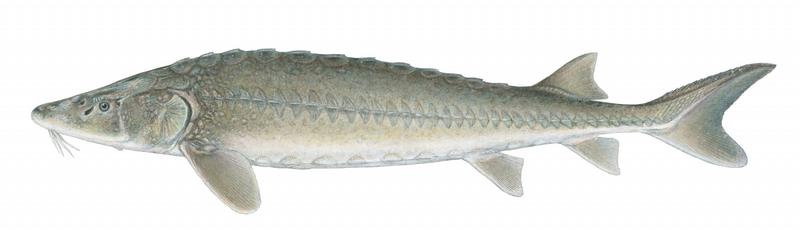
Acipenser fulvescens
Lake Sturgeon
Federal:
Under Review
NS
NatureServeStatus object (G3)
Taxonomic Hierarchy
Actinopterygii (Ray-finned Fishes)
Acipenseriformes (Sturgeons and Paddlefishes)
Acipenseridae (Sturgeons)
Acipenser
Acipenser fulvescens (Lake Sturgeon)
Description
This species account was compiled from
FishBase (Froese, R. and D. Pauly. Editors. 2025. FishBase. World Wide Web electronic publication. www.fishbase.org, version 04/2025.)
and processed using AI-assisted text extraction.
It may contain errors in spelling, punctuation, or formatting.
When citing, please reference the original source rather than this page.
Learn more about our species accounts.
Characters
Body shape: elongated. Single row of preanal shields. Soft area on the top of the head absent and black viscera. Large blotches present on anterior half of upper surface of snout and on back. Lower surface whitish (Ref. 37032). Anal fin origin behind dorsal fin origin; scutes on back and along side same color as skin (Ref. 86798).
Distribution
North America: St. Lawrence-Great Lakes, Hudson Bay, and Mississippi River basins.
Habitat Associations
Freshwater, brackish. demersal. depth range 5-9 m. Found in: streams, lakes, estuaries.
Biology
Inhabits bottom of lakes and large rivers (Ref. 10294), usually in 5-9 m depth, over mud, sand, and gravel. Occasionally enters brackish water. A specimen caught in 1952 was reputed to have been 152 years old (Ref. 6866). Search for food, with the aid of the sensory ability of the barbels, by constantly moving close to the substrate. Omnivorous, virtually anything edible that enters the mouth is sucked up and consumed. The food is worked or pulled in the mouth, often partly ejected and sucked in again (Ref. 1998). Spawning sites are rocky and boulder filled areas along the outside bend of rivers (Ref. 41542). In the 1800s, it was extensively exploited for oil to fire boilers on steamboats, animal feed and fertilizer. Later is was high-valued as smoked, caviar and isinglass (Ref. 117245). In 1951, Canada, 2,000 lbs. of caviar were made from the eggs (Ref. 37032). It continous to be an important source of food for Indigenous people in North America (Ref. 117245). Threatened due to over harvesting, habitat loss and pollution (Ref. 58490).
Max length: 274.0 cm TL; common length: 97.5 cm TL; max weight: 125000 g; max age: 152 years.
Reproductive mode: dioecism; fertilization: external; nonguarders (open water/substratum egg scatterers); parental care: none. Spawning sites are rocky and boulder filled areas along the outside bend of rivers (Ref. 41542).
IUCN Red List Status: Endangered (EN), assessed 2019-09-14. Resilience: Very low (tm=16-26; tmax=152; K=0.04; Fec=50,000).
Commercial or Environmental Importance
Fisheries: commercial; gamefish; aquaculture: experimental; aquarium: public aquariums.
References
Tomelleri, J.R. and M.E. Eberle (1990) Fishes of the central United States. University Press of Kansas, Lawrence, Kansas. 226 p.
Page, L.M. and B.M. Burr (1991) A field guide to freshwater fishes of North America north of Mexico. Houghton Mifflin Company, Boston. 432 p.
Sokolov, L.I. and L.S. Berdicheskii (1989) Acipenseridae. p. 150-153. In J. Holcík (ed.) The freshwater fishes of Europe. Vol. 1, Part II. General introduction to fishes Acipenseriformes. AULA-Verlag Wiesbaden. 469 p.
Balon, E.K. (1975) Reproductive guilds of fishes: a proposal and definition. J. Fish. Res. Board Can. 32(6):821-864.
Beamish, F.W.H., D.L.G. Noakes and A. Rossiter (1998) Feeding ecology of juvenile lake sturgeon, Acipenser fulvescens, in northern Ontario. Can. Field-Nat. 112(3):459-468.
Bigelow, H.B., M.G. Bradbury, J.R. Dymond, J.R. Greeley, S.F. Hildebrand, G.W. Mead, R.R. Miller, L.R. Rivas, W.L. Schroeder, R.D. Suttkus and V.D. Vladykov (1963) Fishes of the western North Atlantic. Part three. New Haven, Sears Found. Mar. Res., Yale Univ.
Page, L.M. and B.M. Burr (2011) A field guide to freshwater fishes of North America north of Mexico. Boston : Houghton Mifflin Harcourt, 663p.
Coad, B.W. and J.D. Reist (2018) Marine fishes of Arctic Canada. Toronto (ON, Canada): University of Toronto Press. xiii+618 p.
Comments On Acipenser fulvescens