
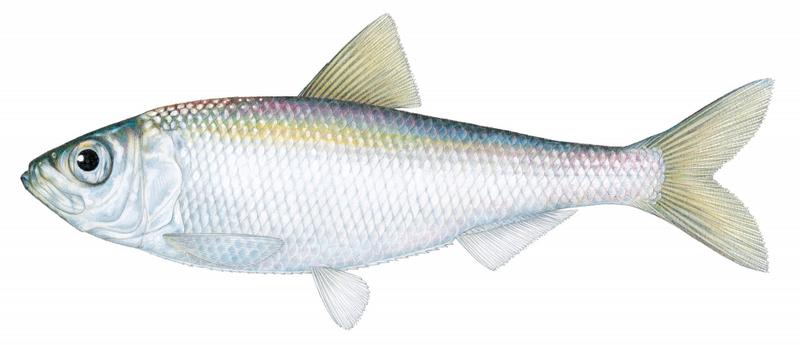
Alosa pseudoharengus
Alewife
NS
G5
Taxonomic Hierarchy
Actinopterygii (Ray-finned Fishes)
Clupeiformes (Herrings, Anchovies and Sardines)
Clupeidae (Herrings)
Alosa
Alosa pseudoharengus (Alewife)
Description
This species account was compiled from
FishBase (Froese, R. and D. Pauly. Editors. 2025. FishBase. World Wide Web electronic publication. www.fishbase.org, version 04/2025.)
and processed using AI-assisted text extraction.
It may contain errors in spelling, punctuation, or formatting.
When citing, please reference the original source rather than this page.
Learn more about our species accounts.
Characters
Body shape: fusiform / normal. Moderately compressed, belly with a distinct keel of scutes. Lower jaw rising steeply within mouth; minute teeth present at front of jaws (disappearing with age). Lower gill rakers increasing with age. A dark spot on shoulder. Distinguished from A. aestivalis by its silvery peritoneum; eye larger than snout length; back greyish green on capture. Striking features: none.
Distribution
North America: Atlantic coast from Red Bay, Labrador in Canada to South Carolina in USA; many landlocked populations exist. Individuals with access to ocean are anadromous, ascending coastal rivers during spring spawning migraitons. Native to Lake Ontario; introduced into other Great Lakes via Welland Canal (first taken in Lake Erie in 1931). Introduced elsewhere, including New River in West Virginia and Virginia, and upper Tennessee River system in Tennessee, USA.
Habitat Associations
Freshwater, brackish, marine. pelagic-neritic. depth range 5-145 m. Found in: streams, lakes, estuaries.
Biology
Occurs in open water over all bottom types (Ref. 86798). Movement of schooling adults apparently restricted to coastal areas proximal to natal estuaries (Ref. 4639). They migrate up rivers and even small streams to spawn in lakes and quiet stretches of rivers, then return to sea shortly after spawning (Ref. 4639); landlocked populations also ascend affluent rivers and streams. Larvae remain in vicinity of spawning grounds, forming schools at sizes less than 10 mm TL, within one to two weeks after hatching (Ref. 4639), then descend in summer and autumn or even as late as November or December. Feed on shrimps and small fishes; the young on diatoms, copepods and ostracods while in rivers. Utilized fresh, dried or salted, smoked and frozen; eaten fried (Ref. 9988). Also used for crab and lobster bait and sometimes for pet food (Ref. 9988). Parasites found are Acanthocephala, cestodes, trematodes and copepods. Overfishing, pollution and impassable dams cause the decline of stocks (Ref. 37032).
Max length: 40.0 cm SL; common length: 30.0 cm SL; max weight: 200 g; max age: 9 years.
Reproductive mode: dioecism; fertilization: external; nonguarders (open water/substratum egg scatterers); parental care: none. Adults migrate up rivers and even small streams, spawn in lakes and quiet stretches of rivers; landlocked populations also ascend affluent rivers and streams; the fry descend in summer and autumn or even as late as November or December. Spawning activity has been observed both diurnally and nocturnally, but with greatest activity at night (Ref. 38797). Spawning activity stops above 27.8°C (Ref. 38881).
Freshwater populations mature earlier and at a smaller average size than saltwater populations (Ref. 4639).
IUCN Red List Status: Least Concern (LC), assessed 2012-03-01. Resilience: Medium (K=0.2; tm=3.6; Fec=2,180).
Commercial or Environmental Importance
Fisheries: commercial.
References
Whitehead, P.J.P. (1985) FAO Species Catalogue. Vol. 7. Clupeoid fishes of the world (suborder Clupeoidei). An annotated and illustrated catalogue of the herrings, sardines, pilchards, sprats, shads, anchovies and wolf-herrings. FAO Fish. Synop. 125(7/1):1-303. Rome: FAO.
Jones, P.W., F.D. Martin and J.D. Hardy Jr. (1978) Development of fishes of the Mid-Atlantic Bight. An atlas of eggs, larval and juvenile stages. Vol. 1. Acipenseridae through Ictaluridae. U.S. Fish Wildl. Ser. Biol. Serv. Program FWS/OBS-78/12. 336 p.
Robins, C.R. and G.C. Ray (1986) A field guide to Atlantic coast fishes of North America. Houghton Mifflin Company, Boston, U.S.A. 354 p.
Bowman, R.E., C.E. Stillwell, W.L. Michaels and M.D. Grosslein (2000) Food of northwest Atlantic fishes and two common species of squid. NOAA Tech. Memo. NMFS-NE 155, 138 p.
Page, L.M. and B.M. Burr (2011) A field guide to freshwater fishes of North America north of Mexico. Boston : Houghton Mifflin Harcourt, 663p.
Comments On Alosa pseudoharengus