
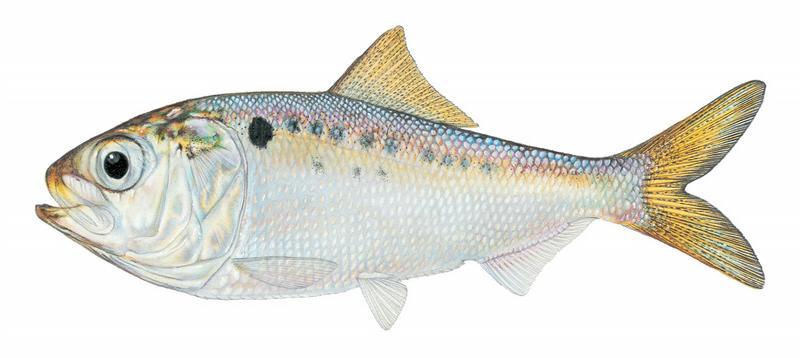
Brevoortia tyrannus
Atlantic Menhaden
NS
G5
Taxonomic Hierarchy
Actinopterygii (Ray-finned Fishes)
Clupeiformes (Herrings, Anchovies and Sardines)
Clupeidae (Herrings)
Brevoortia
Brevoortia tyrannus (Atlantic Menhaden)
Description
This species account was compiled from
Composite (multiple sources) (Carpenter, K.E. (ed.) 2002. The living marine resources of the Western Central Atlantic. FAO Species Identification Guide for Fishery Purposes. FAO, Rome.)
and processed using AI-assisted text extraction.
It may contain errors in spelling, punctuation, or formatting.
When citing, please reference the original source rather than this page.
Learn more about our species accounts.
Synonymy
None / None.
Characters
Body compressed, fairly deep, head ra ther large; abdominal scutes 30 to 35, forming
distinct keel; double line of modified predorsal scales; copious body mucus. Upper jaw with distinct me-
dian notch, no teeth. Gill rakers very fine and numerous. Dorsal fin at about midpoint of body; anal fin fairly
short, its origin located slightly posterior to vertical through posterior dorsal-fin base; 6 branched pelvic-fin
rays; posterior margin of pelvic fin rounded, length of inner rays equal or nearly equal to outer rays;
pelvic-fin base at vertical through anterior portion of dorsal fin. Scales in lateral series 40 to 58 (usu ally
about 45 to 52), those on dorsum above anal-fin base and at base of caudal fin much sm aller and irreg-
ularly placed; exposed part narrow, their posterior edges pectinate with sharp points. Colour: dorsum
dark green-blue, sides brassy green; large dark spot on side posterior to gill c over, usu ally followed by
variable number of sm aller dark spots lying in one or more (up to 6) approximate horizontal lines; fins
yellow to brassy, sometimes with dusky spots.
Body shape: fusiform / normal. Upper jaw with median notch. Pelvic fin with rounded hind margin, inner fin rays equal or nearly equal to outer fin rays when fin folded back. Pre-dorsal scales modified; scales on back, above base of anal fin and at base of tail much smaller and irregularly placed. A black spot behind gill opening, followed along flank by approximately 6 lines of smaller spots (Ref. 188). Silvery, with brassy sides and a dark bluish green back (Ref. 7251). Striking features: none.
Distribution
Atlantic coast (Jupiter Inlet,
Florida, northward to Nova Scotia).
Habitat Associations
Marine, pelagic, usu ally in sh allow waters, both adults and juveniles forming
very large and compact schools at the surface; school sizes vary greatly from year to year; schools comprised
of similar-sized individuals. Inshore in summer; adults migrate into deeper water in winter in the nor thern part
of range, but less offshore migration occurs in the south. North/south migrations (spring and summer versus
autumn) occur, as also short-term migrations in and out of bays and inlets depending on tides, season, and
wea ther. Tolerates wide range of salinities, from almost fresh to full-strength sea water. Spawning season ap-
p arently limited by high temperatures (20.5°C maximum monthly mean); spring spawners (April, May) in Cape
Cod and Long Isl and waters, autumn spawners (October, November) from Long Isl and to North Carolina (plus
some spawning June to August), probably winter spawners off Florida (December to March). Determinate,
multiple spawners; spawn over broad geographic and temporal ranges. Minimum size at maturity about
180 mm. Estimated fecundity 48 000 eggs (180 mm fork length) to over 500 000 eggs (360 mm fork length). Eggs buoyant, spherical, transp arent, 1.3 to 1.9 mm; egg size positively correlated with female size. Recruit-
ment success depends heavily on transport to nearshore areas by water currents. Nursery areas are in estuar-
ies. Feeds by filtering phyto- and zooplankton (diatoms, copepods, euphausiids); as individuals increase in
size trend in feeding regime changes from predominately herbivorous to more omnivorous diet. Reported
catch within the area for 1995 was 27 314 t (USA
only). Great fluctuations occur in abundance,
however. Caught commerci ally with purse
seines, although some are taken in long haul
seines and in pound nets, and minor quantities
with ordinary seines, drag nets and gill nets.
Biology
Maximum 50 cm st andard length, commonly to 35 cm st andard length (nor thern range), 20 cm st andard
length (sou thern range).
Found inshore in summer, but at least some moving into deeper water in winter. Adults are found in near surface waters (Ref. 38984), usually in shallow areas overlying continental shelf, in greatest abundance immediately adjacent to major estuaries (Ref. 4639). Juveniles are also generally pelagic, with smallest size groups farthest up river (Ref. 38986). Form large and very compact schools, both of juveniles and adults. Migrate north - south; also in and out of bays and inlets. Feed by filtering phytoplankton (diatoms (Ref. 5951)) and zooplankton (small crustaceans, annelid worms and detritus (Ref. 5951)). High water temperatures apparently limit breeding. Spawn probably all year; nursery areas in estuaries. Larvae are pelagic (Ref. 38985), probably spend about a month in waters over continental shelf (Ref. 38983), entering estuarine waters at about 10 mm and larger (Ref. 844). Marketed fresh, salted, canned or smoked. Mainly used for production of oil, fertilizer and fishmeal (Ref. 188). Parasites found are isopods, copepod, cestodes and trematodes (Ref. 37032).
Reproductive mode: dioecism; fertilization: external; nonguarders (open water/substratum egg scatterers); parental care: none. Breeding season apparently limited by high water temperatures (20.5°C monthly mean maximum). Spawning activity occurring almost every month in some part of the range (Ref. 2472, 39013, 844). Spawning temperature ranges from 4.4°C to 23.6°C, with peak activity at 15-18°C (Ref. 39014). Salinity ranges from 10 ppt (Ref. 39015) to usually greater than 25 ppt (Ref. 844). Fecundity observed is from 38,000 to 631,000 eggs per season (Ref. 39013).
IUCN Red List Status: Least Concern (LC), assessed 2015-07-07. Resilience: Medium (K=0.4; tm=1-3; Fec=38,000).
Commercial or Environmental Importance
The most im-
portant of Atlantic coast menhadens to fisheries; majority of fishing l andings occur outside the area. Mar-
keted fresh, salted, canned and smoked in lim-
ited amounts, the flesh not being gener ally
esteemed (very oily and bony); chiefly used as a
source of fish oil, also as fish meal and fertilizer
and used as bait in some crustacean fisheries.
References
Whitehead, P.J.P. (1985) FAO Species Catalogue. Vol. 7. Clupeoid fishes of the world (suborder Clupeoidei). An annotated and illustrated catalogue of the herrings, sardines, pilchards, sprats, shads, anchovies and wolf-herrings. FAO Fish. Synop. 125(7/1):1-303. Rome: FAO.
Jones, P.W., F.D. Martin and J.D. Hardy Jr. (1978) Development of fishes of the Mid-Atlantic Bight. An atlas of eggs, larval and juvenile stages. Vol. 1. Acipenseridae through Ictaluridae. U.S. Fish Wildl. Ser. Biol. Serv. Program FWS/OBS-78/12. 336 p.
Robins, C.R. and G.C. Ray (1986) A field guide to Atlantic coast fishes of North America. Houghton Mifflin Company, Boston, U.S.A. 354 p.
Lewis, V.P. and D.S. Peters (1994) Diet of juvenile and adult Atlantic menhaden in estuarine and coastal habitats. Trans. Am. Fish. Soc. 123(5):803-810.
Comments On Brevoortia tyrannus