



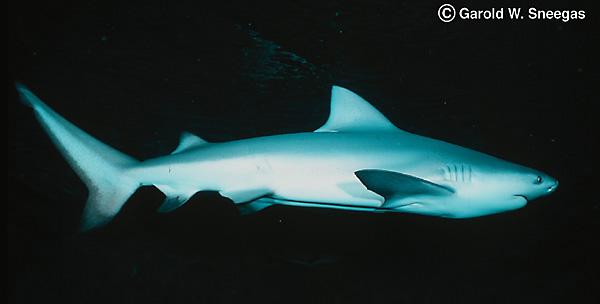


Carcharhinus leucas
Taxonomic Hierarchy
Chondrichthyes (Cartilaginous Fishes)
Carcharhiniformes (Ground Sharks)
Carcharhinidae (Requiem Sharks)
Carcharhinus
Carcharhinus leucas (Bull Shark)
Description
This species account was compiled from
Composite (multiple sources) (McEachran, J.D. and J.D. Fechhelm. Fishes of the Gulf of Mexico. University of Texas Press, Austin.)
and processed using AI-assisted text extraction.
It may contain errors in spelling, punctuation, or formatting.
When citing, please reference the original source rather than this page.
Learn more about our species accounts.
Characters
Rather stout, with a short, blunt snout and a rather low caudal fin with a well-developed ventral lobe. Pre-oral snout length is 0.7 to 1 times internasal width. Upper labial furrows are short and inconspicuous. Anterior nasal flap is broad and triangular shaped. Upper jaw has 12 to 14 tooth rows on each side, and lower jaw has 12 to 13. Teeth located in anterolateral section of upper jaw have very broad, triangular, strongly serrated, and erect to slightly oblique cusps. Gill openings are of moderate length; longest (third) is 3.1% to 4.1% of TL and less than one-third of first dorsal fin base. Pectoral fin and first dorsal fin taper distally. Origin of first dorsal fin is above or slightly posterior to axil of pectoral fin. Second dorsal fin is relatively large but less than one-half height of first dorsal fin and originates anterior to origin of anal fin. Ridge between dorsal fin bases is absent, and caudal peduncle lacks keel.
Color is pale to dark gray dorsally and white ventrally.
Distribution
In the western Atlantic it occurs from Massachusetts to southern Brazil, including the Gulf of Mexico, the Bahamas, and the Caribbean Sea.
Habitat Associations
Tropical to warm temperate seas, generally near shore, and in freshwater with access to the sea in the tropics. Reported from various rivers and lakes including the Mississippi River, Atchafalaya River, Lake Nicaragua, San Juan River, Lake Ysabel, Palula River, Panama Canal, and the Amazon River.
Biology
Food consists of crustaceans, mollusks, elasmobranchs, bony fishes, sea turtles, sea birds, and marine mammals.
Maximum known size is 310 cm TL; males mature at about 157 to 226 cm TL, females mature at 180 to 230 cm TL.
Development is viviparous with a yolk sac placenta. Litters range from 1 to 15 young. Young are 56 to 81 cm TL at birth.
A coastal and freshwater shark inhabiting shallow waters especially in bays, estuaries, rivers, and lakes (Ref. 244). It readily penetrates far up rivers and hypersaline bays and littoral lagoons (Ref. 9997, 44894, 81283). Capable of covering great distances (up to 180 kilometers in 24 hours), moving between fresh and brackish water at random (Ref. 44894). Adults often found near estuaries and freshwater inflows to the sea; young enter rivers and may be found hundreds of km from the sea (Ref. 4967, 44894, 58304). Feeds on bony fishes, other sharks, rays, mantis shrimps, crabs, squid, sea snails, sea urchins, mammalian carrion, sea turtles, and occasionally garbage (Ref. 244, 5578, 44894). Viviparous (Ref. 50449). Gives birth to litters of up to 13 young (Ref. 26938, 44894). Size at birth is 56-81 cm TL (Ref. 81623). Sexual maturity is attained after 10-15 years (at a length between 160-200 centimeters) (Ref. 44894). Though not commercially important, this species is a good food fish (Ref. 12484). Utilized fresh, fresh-frozen or smoked for human consumption, fins for soup, hide for leather, liver for oil, and carcass for fishmeal (Ref. 244). Very hardy and lives well in captivity (Ref. 244). This large shark is potentially dangerous to man (Ref. 81283), probably the most dangerous species of tropical shark (Ref. 244), and it is repeatedly implicated in attacks on humans (Ref. 4967, 44894); attacks in fresh water are rare (Ref. 44894).
IUCN Red List Status: Vulnerable (VU), assessed 2020-11-24. Resilience: Very low (K=0.04-0.15; tm=6-21; tmax=32; Fec=1-13).
Phylogeny and Morphologically Similar Fishes
Distinguished from the other species of the family by the combination of characters described.
Commercial or Environmental Importance
Fisheries: commercial; gamefish.
References
Bigelow and Schroeder 1948a
Springer 1960
Springer 1963
Garrick and Schultz 1963
Clark and von Schmidt 1965
Thorson 1971
Thorson 1976
Hoese and Moore 1977
Applegate et al. 1979
Castro 1983
Branstetter 1984
Compagno 1984
Snelson et al. 1984
C. R. Robins et al. 1986
Branstetter and Stiles 1987
Bonfil et al. 1990
Castro 1993a
Breder, C.M. and D.E. Rosen (1966) Modes of reproduction in fishes. T.F.H. Publications, Neptune City, New Jersey. 941 p.
Compagno, L.J.V. (1984) FAO Species Catalogue. Vol. 4. Sharks of the world. An annotated and illustrated catalogue of shark species known to date. Part 2 - Carcharhiniformes. FAO Fish. Synop. 125(4/2):251-655. Rome: FAO.
Wetherbee, B.M., S.H. Gruber and E. Cortes (1990) Diet, feeding habits, digestion, and consumption in sharks, with special reference to the lemon shark, Negaprion brevirostris. p. 29-47. In H.L. Pratt, Jr., S.H. Gruber and T. Taniuchi (eds.) Elasmobranchs as living resources: advances in the biology, ecology, systematics, and the status of the fisheries. NOAA Tech. Rep. NMFS 90. 517 p.
Halstead, B.W. (1980) Dangerous marine animals. Cornell Maritime Press, Inc., Maryland, U.S.A.
Eccles, D.H. (1992) FAO species identification sheets for fishery purposes. Field guide to the freshwater fishes of Tanzania. Prepared and published with the support of the United Nations Development Programme (project URT/87/016). FAO, Rome. 145 p.
Compagno, L.J.V., D.A. Ebert and M.J. Smale (1989) Guide to the sharks and rays of southern Africa. New Holland (Publ.) Ltd., London. 158 p.
van der Elst, R. (1993) A guide to the common sea fishes of southern Africa. (3rd Ed.). Struik Publishers, Cape Town. 398 p.
Smith, C.L. (1997) National Audubon Society field guide to tropical marine fishes of the Caribbean, the Gulf of Mexico, Florida, the Bahamas, and Bermuda. Alfred A. Knopf, Inc., New York. 720 p.
Cortés, E. (1999) Standardized diet compositions and trophic levels of sharks. ICES J. Mar. Sci. 56:707-717.
McCord, M.E. and S.J. Lamberth (2009) Catching and tracking the world’s largest Zambezi (bull) shark Carcharhinus leucas in the Breede Estuary, South Africa: the first 43 hours. Afr. J. Mar. Sci. 31(1):107-111.
Weigmann, S. (2016) Annotated checklist of the living sharks, batoids and chimaeras (Chondrichthyes) of the world, with a focus on biogeographical diversity. J. Fish Biol. 88(1):1-201. DOI: 10.1111/jfb.12874
Comments On Carcharhinus leucas