
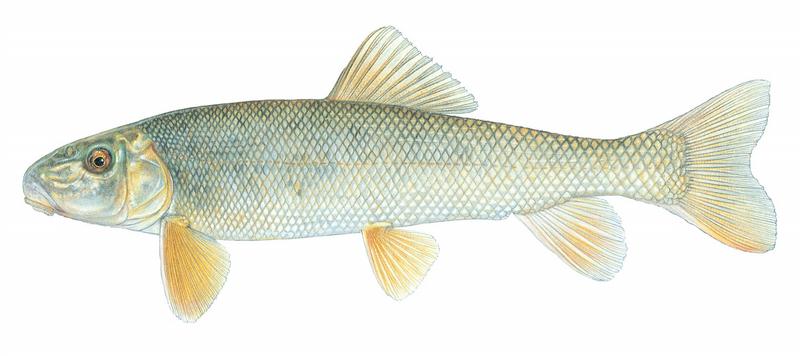
Catostomus commersonii
White Sucker
NS
G5
Taxonomic Hierarchy
Actinopterygii (Ray-finned Fishes)
Cypriniformes (Carps and Minnows)
Catostomidae (Suckers)
Catostomus
Catostomus commersonii (White Sucker)
Description
This species account was compiled from
FishBase (Froese, R. and D. Pauly. Editors. 2025. FishBase. World Wide Web electronic publication. www.fishbase.org, version 04/2025.)
and processed using AI-assisted text extraction.
It may contain errors in spelling, punctuation, or formatting.
When citing, please reference the original source rather than this page.
Learn more about our species accounts.
Characters
Body shape: fusiform / normal.
Distribution
North America: throughout most of Canada to the Atlantic Coast, south through North Carolina to New Mexico in the USA, becoming less common in the southern High Plains.
Habitat Associations
Freshwater, brackish. demersal. Found in: streams, lakes.
Biology
Inhabits a wide range of habitats, from rocky pools and riffles of headwaters to large lakes. Usually occurs in small, clear, cool creeks and small to medium rivers. May be found at a depth greater than 45 m (Ref. 1998). Moves to shallower water near sunrise and sunset to feed. Fry (1.2 cm in length) feed on plankton and other small invertebrates; bottom feeding commences upon reaching a length of 1.6-1.8 cm. Preyed upon by birds, fishes, lamprey, and mammals (Ref. 1998). Flesh is white, flaky, and sweet (Ref. 1998).
Max length: 65.0 cm TL; common length: 40.7 cm TL; max weight: 2940 g; max age: 12 years.
Reproductive mode: dioecism; fertilization: external; nonguarders (open water/substratum egg scatterers); parental care: none. Adults home to certain gravelly spawning streams. Two to four males crowd around a female and press against her with their fins. Eggs are scattered and adhere to the gravel or are carried downstream and adhere to the substrate when the water is calmer. The spawning act lasts for 3-4 seconds and may occur 6-40 times an hour (Ref. 1998). Spent adults return to the lake 10-14 days after spawning began. Most females return to the lake during the first half of the downstream migration followed by most males in the latter half. Downstream fry migration occurs between dusk and dawn (Ref. 10928).
IUCN Red List Status: Least Concern (LC), assessed 2011-10-26. Resilience: Low (tm=6; tmax=12).
Commercial or Environmental Importance
Fisheries: minor commercial; gamefish; aquaculture: commercial.
References
Scott, W.B. and E.J. Crossman (1973) Freshwater fishes of Canada. Bull. Fish. Res. Board Can. 184: xi+1-966.
Tomelleri, J.R. and M.E. Eberle (1990) Fishes of the central United States. University Press of Kansas, Lawrence, Kansas. 226 p.
Page, L.M. and B.M. Burr (1991) A field guide to freshwater fishes of North America north of Mexico. Houghton Mifflin Company, Boston. 432 p.
Etnier, D.A. and W.C. Starnes (1993) The fishes of Tennessee. The University of Tennessee Press, Knoxville, Tennessee, USA. (pls. check date).
Balon, E.K. (1975) Reproductive guilds of fishes: a proposal and definition. J. Fish. Res. Board Can. 32(6):821-864.
Little, A.S., W.M. Tonn, R.F. Tallman and J.D. Reist (1998) Seasonal variation in diet and trophic relationships within the fish communities of the lower Slave River, Northwest Territories, Canada. Environ. Biol. Fishes 53(4):429-445.
Comments On Catostomus commersonii