
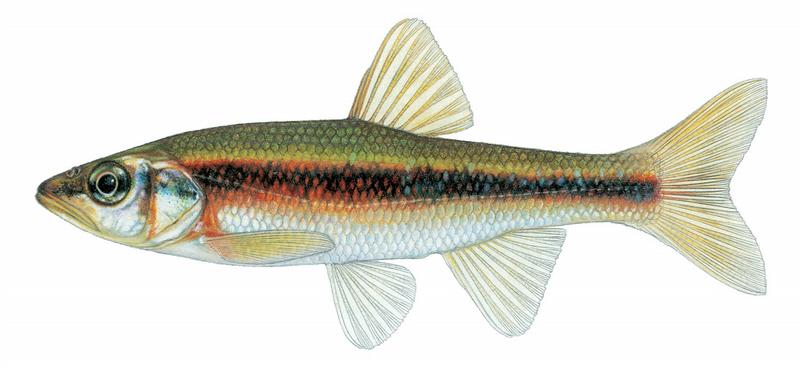
Clinostomus funduloides
Rosyside Dace
NS
G5
Taxonomic Hierarchy
Actinopterygii (Ray-finned Fishes)
Cypriniformes (Carps and Minnows)
Cyprinidae (Carps and Minnows)
Clinostomus
Clinostomus funduloides (Rosyside Dace)
Description
This species account was compiled from
FishBase (Froese, R. and D. Pauly. Editors. 2025. FishBase. World Wide Web electronic publication. www.fishbase.org, version 04/2025.)
and processed using AI-assisted text extraction.
It may contain errors in spelling, punctuation, or formatting.
When citing, please reference the original source rather than this page.
Learn more about our species accounts.
Characters
Body shape: elongated. Clinostomus funduloides can be distinguished by the following characters: complete decurved lateral line with 43-57 lateral scales; anal fin with 9 rays; pharyngeal teeth 2,5-4,2; mouth large and oblique; snout long and pointed; caudal fin large and forked; small scales; dorsal fin origin behind pelvic fin origin. Compressed boy, olive above, dark stripe along back, dark-edged scales on upper side; green to yellow-gold stripe (brightest on large individuals) above dusky stripe along silver side; scattered dark blotches on side of large individuals; white, orange or red lower side; breeding male has dark blue above, bright brick red lower side. Similar to Clinostomus elongatus, Luxilus chrysocephalus and L. cornutus (Ref. 86798).
Distribution
North America: Atlantic Slope (mostly above Fall Line) from lower Delaware River drainage in Pennsylvania to Savannah River drainage in Georgia, USA; Ohio River basin in West Virginia and Ohio to northeast Mississippi, USA. Three subspecies were recognized: Clinostomus funduloides funduloides; Clinostomus funduloides estor; and undescribed subspecies.
Habitat Associations
Freshwater. demersal. Found in: streams.
Biology
Inhabits rocky flowing pools of headwaters, creeks and small rivers. Usually occurs in small clear streams (Ref. 86798).
Max length: 11.5 cm TL; common length: 6.7 cm TL.
IUCN Red List Status: Least Concern (LC), assessed 2011-11-04. Resilience: High (Preliminary K or Fecundity.).
References
Etnier, D.A. and W.C. Starnes (1993) The fishes of Tennessee. The University of Tennessee Press, Knoxville, Tennessee, USA. (pls. check date).
Flemer, D.A. and W.S. Woolcott (1966) Food habits and distribution of the fishes of Tuckahoe Creek, Virginia, with special emphasis on the bluegill, Lepomis m. macrochirus Rafinesque. Chesapeake Sci. 7(2):75-89.
Page, L.M. and B.M. Burr (2011) A field guide to freshwater fishes of North America north of Mexico. Boston : Houghton Mifflin Harcourt, 663p.
Comments On Clinostomus funduloides