
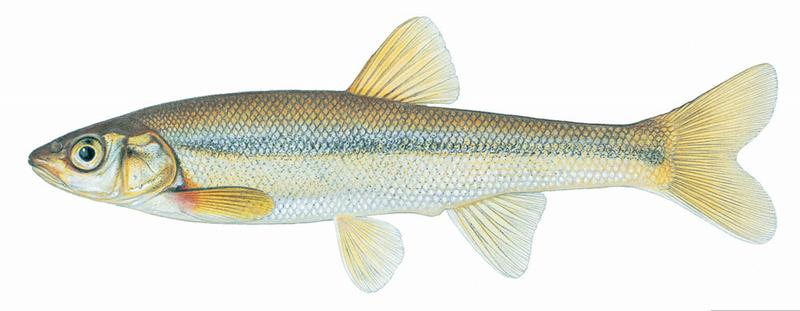
Couesius plumbeus
Lake Chub
NS
G5
Taxonomic Hierarchy
Actinopterygii (Ray-finned Fishes)
Cypriniformes (Carps and Minnows)
Cyprinidae (Carps and Minnows)
Couesius
Couesius plumbeus (Lake Chub)
Description
This species account was compiled from
FishBase (Froese, R. and D. Pauly. Editors. 2025. FishBase. World Wide Web electronic publication. www.fishbase.org, version 04/2025.)
and processed using AI-assisted text extraction.
It may contain errors in spelling, punctuation, or formatting.
When citing, please reference the original source rather than this page.
Learn more about our species accounts.
Characters
Body shape: fusiform / normal. Couesius plumbeus is distinguished by having the following characters: barbel at corner of large, barely subterminal mouth; moderately pointed snout; large eye; head flattened above and below; dorsal fin origin over or slightly behind pelvic fin origin; complete lateral line, 53-70 lateral scales; 8 anal rays, and pharyngeal teeth 2,4-4,2 (Ref. 86798). Spineless fins, normal jaws, and tiny barbel at the corner of the mouth (Ref. 27547). Body moderately compressed and slender, coloration include brown to green above, dark stripe along silver gray side, darkest on young and large male, sometimes black specks on side and belly, dusky caudal spot. Large male may have red at pectoral and pelvic fin origins, corners of mouth (Ref. 86797). In some populations, breeding males develop bright orange-red patches on sides of head and at bases of pectoral fins, but the presence of this color varies from place to place (Ref. 27547).
Distribution
North America: Alaska (Yukon River drainage); throughout most of Canada and northern USA; south to Delaware River in New York, south end of Lake Michigan, Illinois, Platte River system in Colorado, and Columbia River drainage in Washington, USA. Relict population in Mississippi River basin in Iowa, USA. Sometimes hybridizes with Rhinichthys cataractae in Lake Superior (Ref. 4564).
Habitat Associations
Freshwater. demersal. Found in: streams, lakes.
Biology
Inhabits virtually any body of water, standing or flowing, large or small (Ref. 5723, 86798). Common in gravel-bottomed pools and runs of streams and along rocky lake margins (Ref. 86798). Mostly found in shallow water, but may move to deeper parts of lakes during hot weather (Ref. 27547). Feeds on zooplankton, algae, terrestrial and aquatic insects, and small fishes (Ref. 1998).
Max length: 23.0 cm TL; common length: 10.5 cm TL; max age: 5 years.
Reproductive mode: dioecism; fertilization: external; nonguarders (open water/substratum egg scatterers); parental care: none. Spawning individuals form schools that move from lakes or deeper parts of streams to shallower water (Ref. 27547). Also Ref. 10280.
IUCN Red List Status: Least Concern (LC), assessed 2011-11-11. Resilience: Medium (tm=2-4; tmax=5; K=0.36).
Commercial or Environmental Importance
Fisheries: commercial; aquarium: public aquariums.
References
Scott, W.B. and E.J. Crossman (1973) Freshwater fishes of Canada. Bull. Fish. Res. Board Can. 184: xi+1-966.
Balon, E.K. (1975) Reproductive guilds of fishes: a proposal and definition. J. Fish. Res. Board Can. 32(6):821-864.
Morrow, J.E. (1980) The freshwater fishes of Alaska. University of. B.C. Animal Resources Ecology Library. 248p.
Page, L.M. and B.M. Burr (2011) A field guide to freshwater fishes of North America north of Mexico. Boston : Houghton Mifflin Harcourt, 663p.
Comments On Couesius plumbeus