
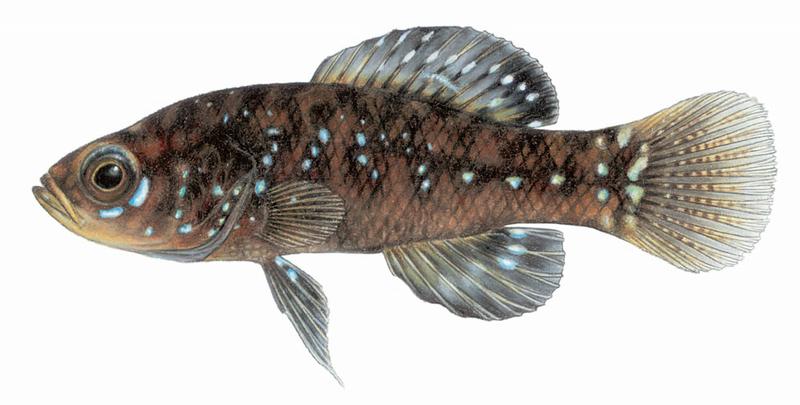
Elassoma evergladei
Everglades Pygmy Sunfish
NS
G5
Taxonomic Hierarchy
Actinopterygii (Ray-finned Fishes)
Perciformes (Perciformes, Also Called the Acanthopteri)
Elassomatidae (Pygmy Sunfishes)
Elassoma
Elassoma evergladei (Everglades Pygmy Sunfish)
Description
This species account was compiled from
FishBase (Froese, R. and D. Pauly. Editors. 2025. FishBase. World Wide Web electronic publication. www.fishbase.org, version 04/2025.)
and processed using AI-assisted text extraction.
It may contain errors in spelling, punctuation, or formatting.
When citing, please reference the original source rather than this page.
Learn more about our species accounts.
Characters
Body shape: elongated.
Distribution
North America: USA from Cape Fear River drainage in North Carolina to Mobile Bay in Alabama; south in Florida to northern edge of Everglades.
Habitat Associations
Freshwater. demersal. Found in: streams, mangroves.
Biology
Occurs in swamps, heavily vegetated sloughs and small sluggish streams, usually over mud. Feeds on worms and crustaceans (Ref. 7020). Oviparous, eggs are deposited in aquatic vegetation, preferably on strands of Ceratophyllum sp. when available (Ref. 58020).
Max length: 3.4 cm TL; common length: 2.3 cm TL.
Reproductive mode: dioecism; fertilization: external; guarders (clutch tenders). Male guards the eggs (Ref. 58020). Produces 40-60 eggs.
IUCN Red List Status: Least Concern (LC), assessed 2011-11-29. Resilience: Low (Fec=25).
Commercial or Environmental Importance
Fisheries: commercial; aquarium: commercial.
References
Riehl, R. and H.A. Baensch (1991) Aquarien Atlas. Band. 1. Melle: Mergus, Verlag für Natur-und Heimtierkunde, Germany. 992 p.
Page, L.M. and B.M. Burr (1991) A field guide to freshwater fishes of North America north of Mexico. Houghton Mifflin Company, Boston. 432 p.
Mettee, M.F. and C. Scharpf (1998) Reproductive behavior, embryology, and larval development of four species of pygmy sunfish. http://www.nanfa.org/articles/elassoma.shtml. Accessed 23/03/07. (paper reprinted from American Currents).
Comments On Elassoma evergladei