
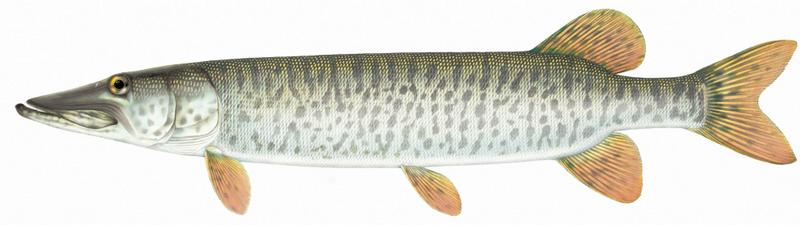
Esox masquinongy
Muskellunge
NS
G5
Taxonomic Hierarchy
Actinopterygii (Ray-finned Fishes)
Esociformes
Esocidae (Pikes)
Esox
Esox masquinongy (Muskellunge)
Description
This species account was compiled from
FishBase (Froese, R. and D. Pauly. Editors. 2025. FishBase. World Wide Web electronic publication. www.fishbase.org, version 04/2025.)
and processed using AI-assisted text extraction.
It may contain errors in spelling, punctuation, or formatting.
When citing, please reference the original source rather than this page.
Learn more about our species accounts.
Characters
Body shape: elongated.
Distribution
North America: Native to St. Lawrence River - Great Lakes, Hudson Bay (Red River), and Mississippi River basins. Introduced elsewhere in the USA. Native populations are protected in portions of Tennessee and Ohio.
Habitat Associations
Freshwater. demersal. Found in: streams, lakes.
Biology
Lives in clear vegetated lakes, quiet pools and backwaters of creeks and small to large rivers (Ref. 205, 10294). Solitary, lurking hunter on other fishes as well as on ducklings, muskrats, and snakes. Oviparous, spawn in spring as the ice melts (Ref. 205).
Max length: 183.0 cm TL; common length: 95.0 cm TL; max weight: 31750 g; max age: 30 years.
Reproductive mode: dioecism; fertilization: external; nonguarders (open water/substratum egg scatterers); parental care: none. Some experts believe that some form of copulation happens during breeding of this species. The female turns on her side to expose her abdomen to the male who then swims against her in a forceful movement. Aftewards, the female takes a rest and deposits her eggs in the sand. This whole activity is presumably repeated one more time (Ref. 205). Other experts believe otherwise, that only a simple and simultaneous discharge of gametes happens during breeding (Ref. 205).
IUCN Red List Status: Least Concern (LC), assessed 2011-12-01. Resilience: Low (K=0.07-0.15; tmax=30).
Commercial or Environmental Importance
Fisheries: commercial; gamefish; aquaculture: commercial; aquarium: public aquariums.
References
Breder, C.M. and D.E. Rosen (1966) Modes of reproduction in fishes. T.F.H. Publications, Neptune City, New Jersey. 941 p.
Page, L.M. and B.M. Burr (1991) A field guide to freshwater fishes of North America north of Mexico. Houghton Mifflin Company, Boston. 432 p.
Crossman, E.J. (1996) Taxonomy and distribution. p. 1-11. In J.F. Craig (ed.) Pike biology and exploration. Chapman and Hall, London. 298 p.
Werner, R.G., B.V. Jonckheere, M.D. Clapsadl and J.M. Farrell (1996) A bioenergetic exploration of piscivory and planktivory during the early life history of two species of freshwater fishes. Mar. Freshwat. Res. 47:113-121.
Wahl, D.H. and R.A. Stein (1991) Food consumption and growth of three esocids: field tests of a bioenergetic model. Trans. Am. Fish. Soc. 120(2):230-246.
Comments On Esox masquinongy