
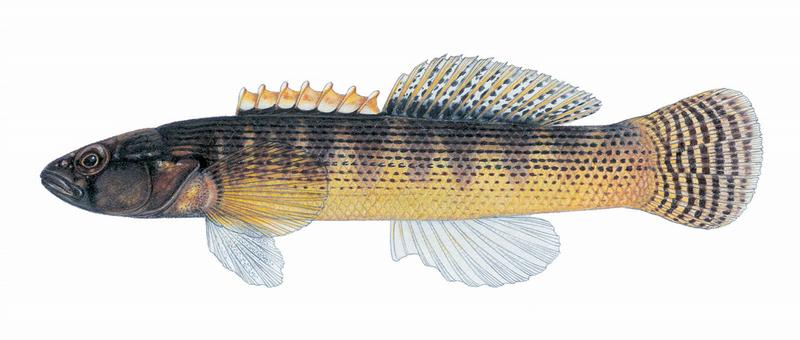
Etheostoma flabellare
Fantail Darter
NS
G5
Taxonomic Hierarchy
Actinopterygii (Ray-finned Fishes)
Perciformes (Perciformes, Also Called the Acanthopteri)
Percidae (Perches)
Etheostoma
Etheostoma flabellare (Fantail Darter)
Description
This species account was compiled from
FishBase (Froese, R. and D. Pauly. Editors. 2025. FishBase. World Wide Web electronic publication. www.fishbase.org, version 04/2025.)
and processed using AI-assisted text extraction.
It may contain errors in spelling, punctuation, or formatting.
When citing, please reference the original source rather than this page.
Learn more about our species accounts.
Characters
Body shape: elongated.
Distribution
North America: Atlantic, Great Lakes, and Mississippi River basins from southern Quebec in Canada to Minnesota, and south to South Carolina (in Santee River system) in northern Alabama, and northeastern Oklahoma in the USA.
Habitat Associations
Freshwater. benthopelagic. Found in: streams, lakes.
Biology
Inhabit rocky riffles of creeks and small to medium rivers (Ref. 5723, 10294); also found in small to medium upland streams (Ref. 10294). Adults feed on midge, blackfly, and caddisfly larvae, mayfly nymphs, isopods, and amphipods (Ref. 10294). Eggs are found clustered on underside of stone and guarded by males (Ref. 7043).
Max length: 8.4 cm TL; common length: 5.2 cm TL; max age: 4 years.
Reproductive mode: dioecism; fertilization: external; guarders (clutch tenders); parental care: paternal. Eggs are found clustered on underside of stone (Ref. 7043). Males guard the eggs (Ref. 7043).
IUCN Red List Status: Least Concern (LC), assessed 2011-12-12. Resilience: Medium (K=0.81; tmax=4; Fec=10-121).
References
Page, L.M. and B.M. Burr (1991) A field guide to freshwater fishes of North America north of Mexico. Houghton Mifflin Company, Boston. 432 p.
Page, L. (1983) Handbook of darters. T.F.H. Publications, Inc. USA. 271 p.
Martin, F.D. (1984) Diets of four sympatric species of Etheostoma (Pisces: Percidae) from southern Indiana: interspecific and intraspecific multiple comparisons. Environ. Biol. Fishes 11(2):113-120.
Comments On Etheostoma flabellare