
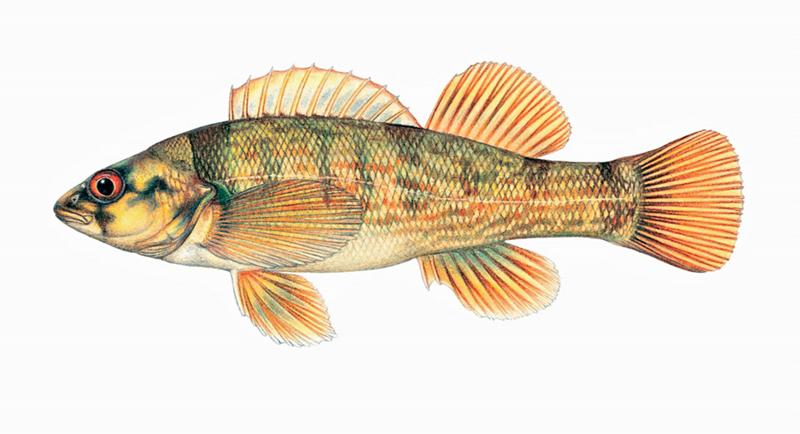
Etheostoma juliae
Yoke Darter
NS
G4
Taxonomic Hierarchy
Actinopterygii (Ray-finned Fishes)
Perciformes (Perciformes, Also Called the Acanthopteri)
Percidae (Perches)
Etheostoma
Etheostoma juliae (Yoke Darter)
Description
This species account was compiled from
FishBase (Froese, R. and D. Pauly. Editors. 2025. FishBase. World Wide Web electronic publication. www.fishbase.org, version 04/2025.)
and processed using AI-assisted text extraction.
It may contain errors in spelling, punctuation, or formatting.
When citing, please reference the original source rather than this page.
Learn more about our species accounts.
Characters
Body shape: elongated.
Distribution
North America: found only in White River drainage (excluding Black River system) in southern Missouri and northern Arkansas, USA.
Habitat Associations
Freshwater. benthopelagic.
Biology
Occur in clear, fast, rocky riffles of creeks and small to medium rivers (Ref. 5723). Spawn in batches (Ref. 36980). Distinct pairing during breeding (Ref. 36980).
Max length: 7.8 cm TL; common length: 4.8 cm TL; max age: 3 years.
Reproductive mode: dioecism; fertilization: external; mating system: monogamy; nonguarders (brood hiders); parental care: none. Breeding pairs were observed on gravel patches behind rocks in 30-60 cm of water. The following account of mating behaviour comes from (Ref. 36980): 'In a typical behavior pattern, 5-10 males were observed following a gravid female..Once the female had selected a suitable spawning site, she would dig head first into the gravel with violent thrashing movements. After two or three attempts, females usually became half buried in the gravel with only head and pectoral fins exposed. During this activity attending males began making rapid darting movements around the female. The attending males moved closer to the buried female until one male, usually the largest, positioned himself beside or over her. Occasionally an even larger male would enter an area and replace the attendant male. After a male had remained with a buried female for a few minutes, he began to aggressively defend a territory. Other males that came within about 20 cm of the female were quickly chased away. In the absence of other males, the attendant male began courtship behavior by darting rapidly around the female, nudging her with his snout and perching along side or on top of her. Courtship lasted up to 30 min. Then the female began a series of rapid quivering movements followed by, or concurrent with, trembling movements by the male. It was assumed that the rapid vibrating movements of the female and male, lasting about 5 sec., indicated deposition of eggs and release of sperm. A female remained buried in the same spot during a series of 3-5 quiverings over a period of nearly 5 min. About 10 min after spawning, both fish moved away from the nest and egg guarding was not observed by either sex.' Eggs are buried under small gravel and pebbles (Ref. 36980).
IUCN Red List Status: Least Concern (LC), assessed 2011-12-16. Resilience: High (K=0.40-0.99; tm=1; tmax=3; Fec=800).
References
Page, L.M. and B.M. Burr (1991) A field guide to freshwater fishes of North America north of Mexico. Houghton Mifflin Company, Boston. 432 p.
Page, L. (1983) Handbook of darters. T.F.H. Publications, Inc. USA. 271 p.
James, P.W. and C.A. Taber (1986) Reproductive biology and age and growth of the yoke darter, Etheostoma juliae. Copeia 1986(2):536-540.
Comments On Etheostoma juliae