
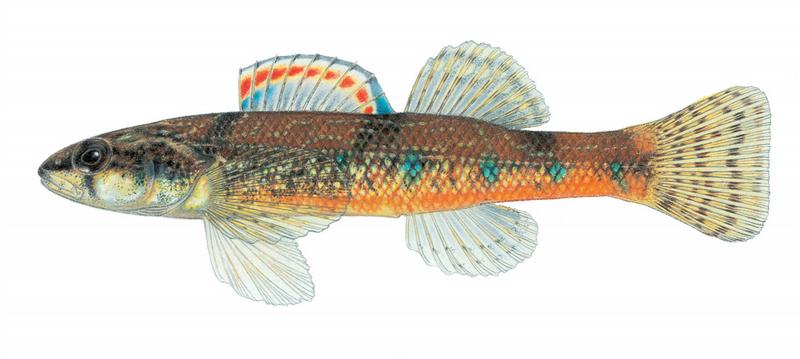
Etheostoma trisella
Trispot Darter
Federal:
Threatened
NS
G1
Taxonomic Hierarchy
Actinopterygii (Ray-finned Fishes)
Perciformes (Perciformes, Also Called the Acanthopteri)
Percidae (Perches)
Etheostoma
Etheostoma trisella (Trispot Darter)
Description
This species account was compiled from
FishBase (Froese, R. and D. Pauly. Editors. 2025. FishBase. World Wide Web electronic publication. www.fishbase.org, version 04/2025.)
and processed using AI-assisted text extraction.
It may contain errors in spelling, punctuation, or formatting.
When citing, please reference the original source rather than this page.
Learn more about our species accounts.
Characters
Body shape: elongated.
Distribution
North America: Coosa River system in Georgia, Alabama and southeastern Tennessee, USA.
Habitat Associations
Freshwater. benthopelagic.
Biology
Inhabit sand and gravel runs of creeks and small rivers. Spawning occurs in headwaters (Ref. 5723, 10294). Adults feed on midge larvae and mayfly nymphs (Ref. 10294). Eggs are found attached to the substrate unguarded (Ref. 7043).
Max length: 5.9 cm TL; common length: 3.6 cm TL.
Reproductive mode: dioecism; fertilization: external; nonguarders (open water/substratum egg scatterers); parental care: none. Eggs are found attached to the substrate unguarded (Ref. 7043).
IUCN Red List Status: Vulnerable (VU), assessed 2012-01-24. Resilience: High (Preliminary K or Fecundity.).
References
Breder, C.M. and D.E. Rosen (1966) Modes of reproduction in fishes. T.F.H. Publications, Neptune City, New Jersey. 941 p.
Page, L.M. and B.M. Burr (1991) A field guide to freshwater fishes of North America north of Mexico. Houghton Mifflin Company, Boston. 432 p.
Page, L. (1983) Handbook of darters. T.F.H. Publications, Inc. USA. 271 p.
Etnier, D.A. and W.C. Starnes (1993) The fishes of Tennessee. The University of Tennessee Press, Knoxville, Tennessee, USA. (pls. check date).
Comments On Etheostoma trisella