
Fundulus confluentus
Marsh Killifish
NS
G5
Taxonomic Hierarchy
Actinopterygii (Ray-finned Fishes)
Cyprinodontiformes
Fundulidae (Topminnows)
Fundulus
Fundulus confluentus (Marsh Killifish)
Description
This species account was compiled from
Composite (multiple sources) (McEachran, J.D. and J.D. Fechhelm. Fishes of the Gulf of Mexico. University of Texas Press, Austin.)
and processed using AI-assisted text extraction.
It may contain errors in spelling, punctuation, or formatting.
When citing, please reference the original source rather than this page.
Learn more about our species accounts.
Characters
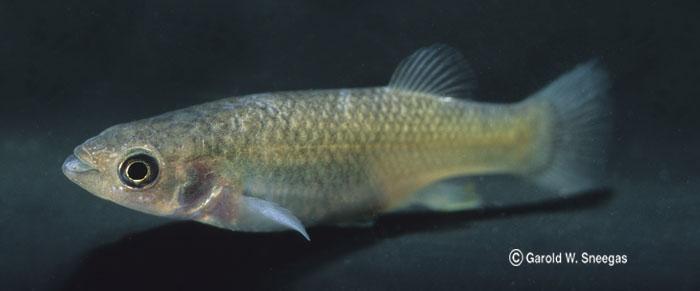
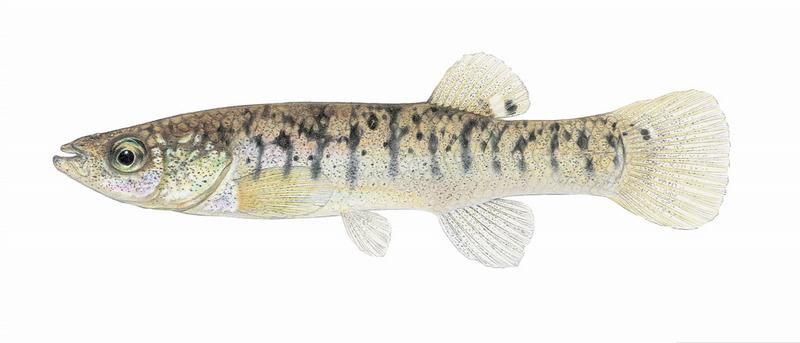
Relatively slender and moderately compressed posteriorly, with a short, rounded snout and a moderately slender caudal peduncle. Snout is slightly oblique and about equal to eye diameter. Mouth is small and horizontal. Jaw teeth consist of outer row of conical, sharp-pointed teeth, and inner band of villiform teeth. Gill rakers on first arch are short and number five. Operculum is attached to shoulder girdle considerably above pectoral fin base. Pectoral fin is moderately narrow and has 14 to 17 rays. Dorsal fin originates posterior to mid-distance between snout and caudal fin base and has 10 or 11 rays. Anal fin originates below or slightly posterior to dorsal fin origin and has 9 or 10 rays. Caudal fin has slightly convex posterior margin and 24 to 29 rays. Lateral line scales number 36 to 40. Measurements (% SL) vary between sexes: males - snout length 7.4-8.6%, head length 30.6-34%, body depth 22.1-27.8%, snout to dorsal fin origin 62.2-69.2%, snout to anal fin origin 64.2-71.6%, caudal peduncle depth 14.7-18.3%; females - snout length 8.2-8.9%, head length 30.1-32%, body depth 22.7-24.1%, snout to dorsal fin origin 67-71.4%, snout to anal fin origin 66.6-73%, caudal peduncle depth 14.2-15.1%.
Males are dark olive brown or dark green dorsally, with 14 to 18 silvery or white bars on flank, and belly is white, yellow, golden, or yellow-orange. Dorsal fin usually has distinct black ocellus near distal edge. Females are brown to olive dorsally, with poorly defined vertical bars on side, and belly is pale, dusky white, yellowish, or slightly greenish. Distinct ocellus is either present or absent on dorsal fin.
Distribution
Western North Atlantic from Chesapeake Bay to southern Florida and northeastern Gulf of Mexico to Mississippi.
Habitat Associations
Grassy backwaters and brackish bays to freshwater; not along open beaches. Depth range not specified.
Grassy backwaters
Biology
Maximum known size is 75 mm TL.
Occurs mainly in grassy backwaters and brackish bays, not along open beaches. Also found in fresh water (Ref. 7251). Omnivorous and feeds on small fishes, insects, small crustaceans, plants, annelid worms and mollusks (Ref. 93252). Not a seasonal killifish. Is difficult to maintain in aquarium (Ref. 27139).
Reproductive mode: dioecism; fertilization: external; mating system: monogamy; nonguarders (open water/substratum egg scatterers); parental care: none. Distinct pairing during breeding (Ref. 205). Oviparous (Ref. 205). Mature males during the breeding season are dark green, with pearly spots sometimes arranged vertically, these features having similarities with males of F. heteroclitus (Ref. 205). Females are brownish olive in color, with black dots above and black short narrow bars on the body (Ref. 205). Eggs are capable of surviving out of water for long periods of time (Ref. 45994).
IUCN Red List Status: Least Concern (LC), assessed 2012-01-30. Resilience: High (Preliminary K or Fecundity.).
Phylogeny and Morphologically Similar Fishes
Distinguished from other species of the family by the combination of characters described.
Commercial or Environmental Importance
Fisheries: commercial; aquarium: commercial.
References
Tabb and Manning 1961
Rosen 1973
Hardy 1978
C. R. Robins et al. 1986
Boschung 1992
Breder, C.M. and D.E. Rosen (1966) Modes of reproduction in fishes. T.F.H. Publications, Neptune City, New Jersey. 941 p.
Robins, C.R. and G.C. Ray (1986) A field guide to Atlantic coast fishes of North America. Houghton Mifflin Company, Boston, U.S.A. 354 p.
Huber, J.H. (1996) Killi-Data 1996. Updated checklist of taxonomic names, collecting localities and bibliographic references of oviparous Cyprinodont fishes (Atherinomorpha, Pisces). Société Française d'Ichtyologie, Muséum National d'Histoire Naturelle, Paris, France, 399 p.
Comments On Fundulus confluentus