

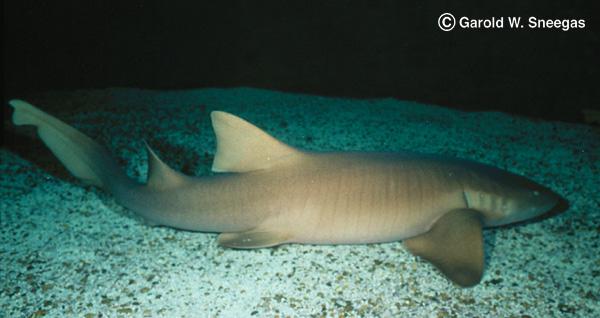
Ginglymostoma cirratum
Taxonomic Hierarchy
Chondrichthyes (Cartilaginous Fishes)
Orectolobiformes (Carpet Sharks)
Ginglymostomatidae (Nurse Sharks)
Ginglymostoma
Ginglymostoma cirratum (Nurse Shark)
Description
This species account was compiled from
Composite (multiple sources) (McEachran, J.D. and J.D. Fechhelm. Fishes of the Gulf of Mexico. University of Texas Press, Austin.)
and processed using AI-assisted text extraction.
It may contain errors in spelling, punctuation, or formatting.
When citing, please reference the original source rather than this page.
Learn more about our species accounts.
Characters
Nasal barbels extend to mouth. Teeth are conical and rather broad, with a small, short median cusp and several large lateral cusplets. Spiracle is minute. Pectoral, dorsal, and anal fins have rounded tips. Pectoral fin is broad. First dorsal fin is considerably larger than second dorsal fin and anal fin. Caudal fin is greater than one-fourth total length.
Color is yellowish brown to grayish brown and is either patterned with dark spots and obscure saddle markings on dorsal surface or lacks these markings. Markings are most distinct in small specimens.
Distribution
Rhode Island to southern Brazil, including the Gulf of Mexico
Habitat Associations
Tropical to warm temperate waters of the Atlantic and eastern Pacific, between the shoreline and 12 m depth
On or near the bottom
Biology
Benthic invertebrates such as sea urchins, bivalves, gastropods, squids, octopods, crabs, spiny lobsters, stingrays, and bony fishes
Maximum known size is about 430 cm TL
Development is ovoviviparous, litters range from 21 to 28 young. Males mature at about 225 cm TL, females at about 230 to 240 mm TL, and young are about 27 to 28 cm TL at birth.
Found on continental and insular shelves. Solitary (Ref. 26340) and sluggish fish, often encountered lying on the bottom (Ref. 9987). Nocturnal, feeding on bottom invertebrates such as spiny lobsters, shrimps, crabs, sea urchins, squids, octopi, snails and bivalves, and fishes like catfishes, mullets, puffers and stingrays. Ovoviviparous with 21 to 28 young in a litter (Ref. 9987, 43278). Kept in captivity for researches. May attack humans if they are molested or stepped upon accidentally. Edible, but mainly valued for its hide, which makes extremely tough and durable leather (Ref. 9987). Common over shallow sand flats, in channels, and around coral reefs; young may be found among prop roots of red mangroves (Ref. 26938).
IUCN Red List Status: Vulnerable (VU), assessed 2019-07-05. Resilience: Low (K=0.14; tmax=25; Fec=21-28).
Phylogeny and Morphologically Similar Fishes
Distinguished from other species of the family by the combination of characters described
Commercial or Environmental Importance
Fisheries: minor commercial; gamefish; aquarium: public aquariums.
References
Bigelow and Schroeder 1948a
S. Springer 1963
Clark and von Schmidt 1965
Hoese and Moore 1977
Applegate et al. 1979
Castro 1983
Compagno 1984
Quero 1984e
C. R. Robins et al. 1986
Bonfil et al. 1990
Compagno, L.J.V. (1984) FAO Species Catalogue. Vol. 4. Sharks of the world. An annotated and illustrated catalogue of shark species known to date. Part 1 - Hexanchiformes to Lamniformes. FAO Fish. Synop. 125(4/1):1-249. Rome, FAO.
Smith, C.L. (1997) National Audubon Society field guide to tropical marine fishes of the Caribbean, the Gulf of Mexico, Florida, the Bahamas, and Bermuda. Alfred A. Knopf, Inc., New York. 720 p.
Cortés, E. (1999) Standardized diet compositions and trophic levels of sharks. ICES J. Mar. Sci. 56:707-717.
Compagno, L.J.V. (2001) Sharks of the world. An annotated and illustrated catalogue of shark species known to date. Vol. 2. Bullhead, mackerel and carpet sharks (Heterodontiformes, Lamniformes and Orectolobiformes). FAO Spec. Cat. Fish. Purp. 1(2):269 p. FAO, Rome.
Love, M.S., C.W. Mecklenburg, T.A. Mecklenburg and L.K. Thorsteinson (2005) Resource inventory of marine and estuarine fishes of the West Coast and Alaska: A checklist of North Pacific and Arctic Ocean species from Baja California to the Alaska-Yukon border. U.S. Department of the Interior, U.S. Geological Survey, Biological Resources Division, Seattle, Washington, 98104.
Comments On Ginglymostoma cirratum