
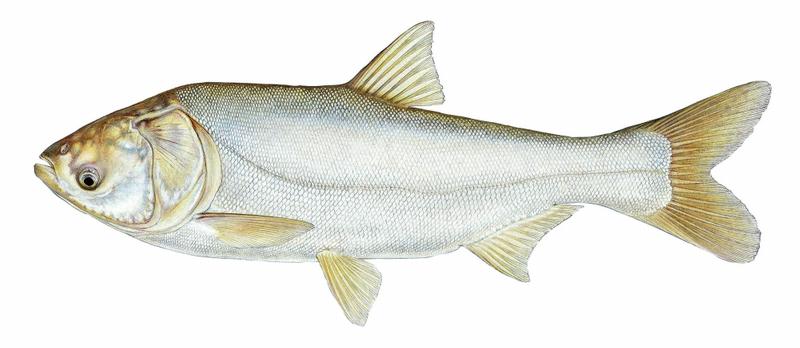
Hypophthalmichthys molitrix
Silver Carp
NS
G5
Taxonomic Hierarchy
Actinopterygii (Ray-finned Fishes)
Cypriniformes (Carps and Minnows)
Cyprinidae (Carps and Minnows)
Hypophthalmichthys
Hypophthalmichthys molitrix (Silver Carp)
Description
This species account was compiled from
FishBase (Froese, R. and D. Pauly. Editors. 2025. FishBase. World Wide Web electronic publication. www.fishbase.org, version 04/2025.)
and processed using AI-assisted text extraction.
It may contain errors in spelling, punctuation, or formatting.
When citing, please reference the original source rather than this page.
Learn more about our species accounts.
Characters
Body shape: fusiform / normal. Diagnosis: Body olivaceous to silvery. Barbels absent. Keels extend from isthmus to anus. Edge of last simple dorsal ray not serrated. Branched anal rays 12-13.5 (Ref. 13274). It differs from Hypophthalmichthys nobilis by having sharp scaleless keel from pectoral region to anal origin, 650-820 long, slender gill rakers, head length 24-29% of standard length, and plain pale coloration, greenish grey above, whitish below (Ref. 59043).
Description: Body club-shaped (Ref. 52193). Large head; mouth small, upturned; eyes set low, below the level of the mouth; gill rakers attached to each other to form a sieve; intestine extended (Ref. 52193). Dorsal fin with 3 unbranched and 7 branched rays; anal fin with 3 unbranched and 12 branched rays; pelvic fins in front of origin of dorsal fin (Ref. 52193). Scales minute; 110-115 scales in lateral line (Ref. 52193).
Colouration: Body olivaceous to silvery (Ref. 40476)
Distribution
Asia: Native to most major Pacific dainages of East Asia from Amur to Xi Jiang, China (Ref. 59043) and Hanoi, Vietman (Ref. 120939). Introduced around the world for aquaculture and control of algal blooms. Several countries report adverse ecological impact after introduction (Ref. 1739). Often confused with Hypophthalmichthys nobilis (Ref. 59043).
Habitat Associations
Freshwater, brackish. benthopelagic. depth range 0-20 m. Found in: streams, lakes, estuaries.
Biology
Found in their natural range in rivers with marked water-level fluctuations and overwinters in middle and lower stretches, swimming just beneath the surface. They feed in shallow (0.5-1.0 m deep) and warm (over 21°C) backwaters, lakes and flooded areas with slow current on phytoplankton and zooplankton (Ref. 30578, 10294). Bigger individuals from about 1.5 cm SL feed only on phytoplankton while larvae and small juveniles prey on zooplankton (Ref. 59043). Adults breed in rivers or tributaries over shallow rapids with gravel or sand bottom, in upper water layer or even at surface during floods when the water level increases by 50-120 cm above normal level. Conditions for spawning include high current (0.5-1.7 m/s), turbid water, temperatures above 15°C (usually 18-26°C) and high oxygen concentrations (Ref. 59043). Spawning ceases if conditions change (especially sensitive to water-level fall) and resumes again when water level increases. Juveniles and adults form large schools during spawning season. Mature individuals undertake long distance upriver migration at start of a rapid flood and water-level increase, able to leap over obstacles up to 1 m. After spawning, adults migrate to foraging habitats, In autumn, adults move to deeper places in main course of river where they remain without feeding. Larvae drift downstream and settle in floodplain lakes, shallow shores and backwaters with little or no current (Ref. 59043). In aquaculture, it can survive brackish water (up to 7 ppt) when released into estuaries and coastal lakes (Ref. 59043). Escape from fish farms are widely known even as they are stocked in large rivers and almost all still water bodies like lakes and ponds. Utilized fresh for human consumption and also introduced to many countries where its ability to clean reservoirs and other waters of clogging algae is appreciated even more than its food value (Ref. 9987). One of among 3 or 4 species of cyprinids whose world production in aquaculture exceeds 1 million tons per year (Ref. 30578).
Max length: 120.0 cm TL; common length: 18.0 cm SL; max weight: 50000 g; max age: 20 years.
Reproductive mode: dioecism; fertilization: external; nonguarders (open water/substratum egg scatterers); parental care: none.
IUCN Red List Status: Near Threatened (NT), assessed 2011-01-20. Resilience: Medium (K=0.16-0.29; tm=2-6).
Commercial or Environmental Importance
Fisheries: commercial; aquaculture: commercial.
References
Shao, K.-T. and P.L. Lim (1991) Fishes of freshwater and estuary. Encyclopedia of field guide in Taiwan. Recreation Press, Co., Ltd., Taipei. vol. 31. 240 p. (in Chinese).
Skelton, P.H. (1993) A complete guide to the freshwater fishes of southern Africa. Southern Book Publishers. 388 p.
Kottelat, M., A.J. Whitten, S.N. Kartikasari and S. Wirjoatmodjo (1993) Freshwater fishes of Western Indonesia and Sulawesi = Ikan air tawar Indonesia Bagian Barat dan Sulawesi. Periplus Editions, Hong Kong. 293 p.
Cremer, M.C. and R.O. Smitherman (1980) Food habits and growth of silver and bighead carp in cages and ponds. Aquaculture 20:57-64.
Keith, P. and J. Allardi (coords.) (2001) Atlas des poissons d'eau douce de France. Muséum national d’Histoire naturelle, Paris. Patrimoines naturels, 47:1-387.
Kottelat, M. and J. Freyhof (2007) Handbook of European freshwater fishes. Publications Kottelat, Cornol and Freyhof, Berlin. 646 pp.
Page, L.M. and B.M. Burr (2011) A field guide to freshwater fishes of North America north of Mexico. Boston : Houghton Mifflin Harcourt, 663p.
Teletchea, F., A. Fostier, E. Kamler, J-N. Gardeur, P-Y. Le Bail, B. Jalabert and P. Fontaine (2009) Comparative analysis of reproductive traits in 65 freshwater fish species: application to the domestication of new fish species. Rev. Fish Biol. Fish. 19:403-430.
Esmaeili, H.R. and M.S. Johal (2015) Food and feeding habits of silver carp, Hypophthalmichthys molitrix (Val., 1844) in Gobindsagar Reservoir, India. Int. J. Aquat. Biol. 3(4):225-235. DOI: 10.22034/ijab.v3i4.101
Comments On Hypophthalmichthys molitrix