
Hyporhamphus unifasciatus
Atlantic Silverstripe Halfbeak
NS
GNR
Taxonomic Hierarchy
Actinopterygii (Ray-finned Fishes)
Beloniformes
Hemiramphidae (Halfbeaks)
Hyporhamphus
Hyporhamphus unifasciatus (Atlantic Silverstripe Halfbeak)
Description
This species account was compiled from
Composite (multiple sources) (McEachran, J.D. and J.D. Fechhelm. Fishes of the Gulf of Mexico. University of Texas Press, Austin.)
and processed using AI-assisted text extraction.
It may contain errors in spelling, punctuation, or formatting.
When citing, please reference the original source rather than this page.
Learn more about our species accounts.
Characters
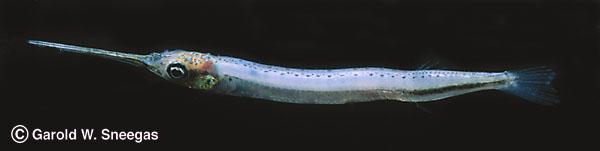
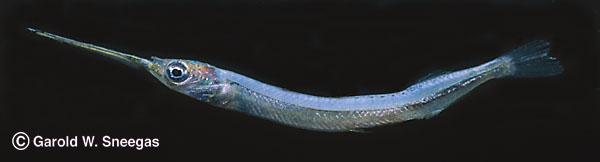
Elongate, moderately compressed, and oval in cross section, with an elongated, beaklike lower jaw; pre-orbital ridge lateral to naris; and relatively short pectoral fins. Jaw teeth are in bands and are weak, with those of upper jaw unicuspid and those of lower jaw tricuspid. Gill rakers on first arch number 26 to 35. Snout length is 8.2% to 8.8%, head length is 21.9% to 22.7%, head width is 6.9% to 7.6%, orbit diameter is 5% to 5.8%, interorbital width is 5.5% to 6.1%, anterior dorsal fin lobe is 7.5% to 10.7%, anterior anal fin lobe is 6.9% to 11.9%, pectoral fin length is 11.6% to 13.6%, and pelvic fin length is 7.3% to 8.3% of SL. Pectoral fin has 9 to 12 (usually 10 or 11) rays. Dorsal fin is emarginate and has 13 or 16 rays. Pelvic fin fails to reach origin of dorsal fin. Anal fin is similar in shape and size to dorsal fin and has 14 to 18 rays. Caudal peduncle is moderately slender. Caudal fin is emarginate to slightly forked, with lower lobe extending beyond upper lobe. Body, upper jaw, and dorsal and anal fins are covered with cycloid scales.
Color is greenish dorsally and silvery ventrally, with three narrow black lines running from head to origin of dorsal fin. Fleshy tip of lower jaw is yellowish red.
Distribution
Western Atlantic from Bermuda and southern Florida to Uruguay, including the Gulf of Mexico off the west coast of Florida
Gulf of Mexico off Veracruz
Habitat Associations
Inshore waters, including estuaries
Biology
Food consists of floating algae, sea grasses, small invertebrates, and fishes.
Maximum known size is 270 mm TL
An inshore, surface-dwelling species forming sizeable schools, frequently entering estuaries (Ref. 3723). Uncommon over reefs (Ref. 9710). Omnivorous, feeds on algae and other small animals (Ref. 3723). Caught with 'mandinga' nets in Venezuela, often using lights (Ref. 3723). Edible but not really appreciated (Ref. 3723).
Reproductive mode: dioecism; fertilization: external. Oviparous (Ref. 36576).
IUCN Red List Status: Least Concern (LC), assessed 2019-03-01. Resilience: High (Preliminary K or Fecundity.).
Commercial or Environmental Importance
Fisheries: minor commercial.
References
Beebe and Tee-Van 1933
Bohlke and Chaplin 1968
Collette 1978c
Snelson 1983
C. R. Robins et al. 1986
Cervigon 1991
Collette, B.B. (1978) Hemiramphidae. In W. Fischer (ed.) FAO species identification sheets for fishery purposes. Western Central Atlantic (Fishing Area 31), Volume 2. FAO, Rome.
Humann, P. and N. DeLoach (1993) Reef fish identification. Galápagos. New World Publications, Inc., Florida. 267 p.
Robins, C.R. and G.C. Ray (1986) A field guide to Atlantic coast fishes of North America. Houghton Mifflin Company, Boston, U.S.A. 354 p.
Watson, W. (1996) Hemiramphidae: halfbeaks. p. 634-641. In H.G. Moser (ed.) The early stages of fishes in the California Current Region. California Cooperative Oceanic Fisheries Investigations (CalCOFI) Atlas No. 33. Allen Press, Inc., Lawrence, Kansas. 1505 p.
Carr, W.E.S. and C.A. Adams (1973) Food habits of juvenile marine fishes occupying seagrass beds in the estuarine zone near crystal river, Florida. Trans. Am. Fish. Soc. 102(3):511-540.
Jiménez Prado, P. and P. Béarez (2004) Peces Marinos del Ecuador continental. Tomo 2: Guía de Especies / Marine fishes of continental Ecuador. Volume 2: Species Guide. SIMBIOE/NAZCA/IFEA.
Banford, H.M. (2010) Hyporhamphus collettei, a new species of inshore halfbeak (Hemiramphidae) endemic to Bermuda, with comments on the biogeography of the Hyporhamphus unifasciatus species group. Proc. Biol. Soc. Wash. 123(4):345-358.
Cruz-Sánchez, J.L., A. Toro-Ramírez and G.R. Poot-López (2024) Size-frequency, length-weight, and length-length relationship of two species of halfbeaks (Family: Hemiramphidae) from the north coast of the Yucatan peninsula, Mexico. Latin Am. J. Aquat. Res. 52(4):652-658. DOI: 10.3856/vol52-issue4-fulltext-3217
Comments On Hyporhamphus unifasciatus