
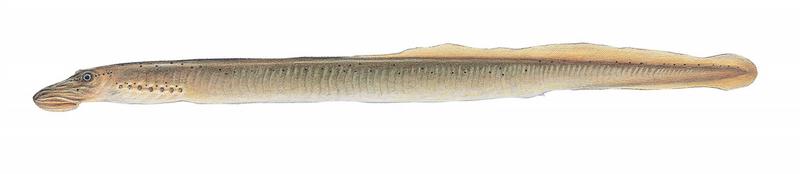
Ichthyomyzon bdellium
Ohio Lamprey
NS
G3
Taxonomic Hierarchy
Cephalaspidomorphi (Lampreys)
Petromyzontiformes (Lampreys)
Petromyzontidae (Lampreys)
Ichthyomyzon
Ichthyomyzon bdellium (Ohio Lamprey)
Description
This species account was compiled from
FishBase (Froese, R. and D. Pauly. Editors. 2025. FishBase. World Wide Web electronic publication. www.fishbase.org, version 04/2025.)
and processed using AI-assisted text extraction.
It may contain errors in spelling, punctuation, or formatting.
When citing, please reference the original source rather than this page.
Learn more about our species accounts.
Characters
Body shape: eel-like. Distinguished by the following characters: oral disc as wide or wider than head; teeth sharp and well developed; usually 56-62 trunk myomeres; black on lateral-line pores; one slightly notched dorsal fin (Ref. 86798). Other diagnostic features: 11.7-27.9 cm TL. Body proportions, as percentage of TL (based on 51 specimens measuring 12.5-25.9 cm TL): prebranchial length, 10.4-14.0; branchial length, 7.6-10.7; trunk length, 47.3-54.3; tail length, 21.4-31.2; eye length, 0.6-1.8; disc length, 6.2-9.5. The urogenital papilla length, as a percentage of branchial length, in 10 spawning males measuring 11.7-24.7 cm TL, 8.7-16.0. Trunk myomeres, 53-62. Dentition: supraoral lamina, 2-3 teeth (if 3, the median one shortest); infraoral lamina, 5-11 teeth; typically 4 endolateral teeth on each side, but 5 teeth also occur; 7-10, mode of 8, bicuspid endolaterals in total, the other endolaterals, if any, unicuspid; 3-4 rows of anterials, usually 3; first row of anterials, 3 teeth, all unicuspid; 4-8 rows of exolaterals on each side, usually 6; 2 rows of posterials; first row of posterials, 8-9, all unicuspid; transverse lingual lamina moderately to strongly w-shaped, with numerous cusps; longitudinal lingual laminae, number of teeth unrecorded. Velar tentacles, 2-3, smooth. Body coloration (live), slate gray dorsal aspect and silvery gray lateral and ventral aspects. Lateral line neuromasts darkly pigmented, although they may be unpigmented in recently transformed adults. Caudal fin pigmentation, 75% or more. Caudal fin shape, rounded. Oral fimbriae, 103-144. Oral papillae, 20-32 (Ref. 89241).
Distribution
North America: Ohio River basin from extreme southwestern New York west to northern Indiana and eastern Illinois and south to northern Alabama in USA.
Habitat Associations
Freshwater. demersal. Found in: streams.
Biology
Inhabit smaller, more upland rivers, and less encountered in reservoirs (Ref. 10294). Freshwater. Ammocoetes and spawning adults inhabit brooks and small rivers, while feeding adults inhabit medium-sized to large rivers (Ref.89241). Ammocoete larvae live near debris in muddy pools and backwaters. Known to parasitize suckers (Ref. 10294).
Max length: 30.0 cm TL; common length: 19.1 cm TL; max age: 1 years.
Reproductive mode: dioecism; fertilization: external.
IUCN Red List Status: Least Concern (LC), assessed 2012-02-17. Resilience: Low (Semelparous species, assuming tm (= tmax) > 4).
References
Page, L.M. and B.M. Burr (1991) A field guide to freshwater fishes of North America north of Mexico. Houghton Mifflin Company, Boston. 432 p.
Etnier, D.A. and W.C. Starnes (1993) The fishes of Tennessee. The University of Tennessee Press, Knoxville, Tennessee, USA. (pls. check date).
Page, L.M. and B.M. Burr (2011) A field guide to freshwater fishes of North America north of Mexico. Boston : Houghton Mifflin Harcourt, 663p.
Renaud, C.B. (2011) Lampreys of the world. An annotated and illustrated catalogue of lamprey species known to date. FAO Species Catalogue for Fishery Purposes. No. 5. Rome, FAO. 109 pp.
Comments On Ichthyomyzon bdellium