

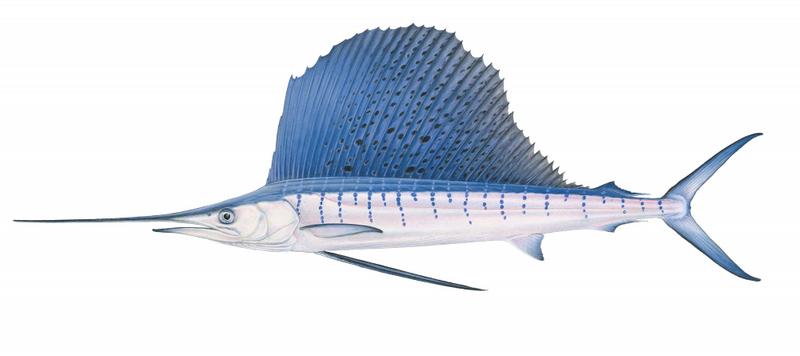
Istiophorus platypterus
Taxonomic Hierarchy
Actinopterygii (Ray-finned Fishes)
Perciformes (Perciformes, Also Called the Acanthopteri)
Istiophoridae (Billfishes)
Istiophorus
Istiophorus platypterus (Sailfish)
Description
This species account was compiled from
FishBase (Froese, R. and D. Pauly. Editors. 2025. FishBase. World Wide Web electronic publication. www.fishbase.org, version 04/2025.)
and processed using AI-assisted text extraction.
It may contain errors in spelling, punctuation, or formatting.
When citing, please reference the original source rather than this page.
Learn more about our species accounts.
Characters
Body shape: elongated. This species is distinguished by the following characters: slender elongate and fairly compressed with a high, sail-like first dorsal fin; upper jaw prolonged into a very long beak, slender and round in cross-section; jaws and palatines with villiform teeth; no gill rakers; two dorsal fins, the first very large (42-49 rays) the second small (6-7 rays); pectoral fins 18-20 rays; pelvic fins I, 2 soft rays fused together, very long and narrow, depressible into a groove; caudal peduncle with double keels on each side; body covered with small, embedded scales with 1 or 2 blunt points. Colour of back dark with about 20 bluish vertical bars; belly pale silver; membrane of first dorsal fin blue- black with numerous dark spots; bases of first and second anal fins often tinged with silvery white; remaining fins blackish brown or dark blue (Ref. 43, 26938). Striking features: striking type of mouth.
Distribution
Indo-Pacific: tropical and temperate waters approximately 45°- 50°N and 40°-35°S in the western Pacific, 35°N and 35°S in the eastern Pacific; 45°S in western Indian Ocean and 35°S in eastern Indian Ocean. Entered Mediterranean Sea from Red sea via Suez Canal. Highly migratory species. Some authors recognize a single worldwide species, Istiophorus platypterus (Shaw & Nodder 1792) but we follow Nakamura 1990 (Ref. 10820) retaining the usage of Istiophorus platypterus for the Indo-Pacific sailfish and Istiophorus albicans for the Atlantic sailfish in recognition of the differences between them.
Habitat Associations
Marine. pelagic-oceanic. depth range 0-200 m. Found in: coral reefs.
Biology
Oceanic and epipelagic species usually found above the thermocline. Most densely distributed in waters close to coasts and islands (Ref. 9688). Most likely schools by size. Undergoes spawning migrations in the Pacific. Feeds mainly on fishes, crustaceans and cephalopods. Caught mainly with longlines, set nets, and sometimes by trolling and harpooning from boats (Ref. 43). Utilized fresh, smoked and frozen; also used for sashimi and sushi; eaten broiled and baked (Ref. 9987).
Max length: 348.0 cm FL; common length: 270.0 cm TL; max weight: 100240 g; max age: 13 years.
Reproductive mode: dioecism; fertilization: external; nonguarders (open water/substratum egg scatterers); parental care: none. Seems to spawn throughout the year in tropical and subtropical waters of the Pacific with peak spawning occurring in the respective local summer seasons. Spawning occurs with males and females swimming in pairs or with two or three males chasing a single female (probably a mating behavior). The ripe ovarian eggs are about 0.85 mm in diameter and have a single oil globule; there are no structures on the vitalize membrane and the egg is transparent. Eggs shed from captured female in the Indian Ocean averaged 1.304 mm in diameter.
IUCN Red List Status: Vulnerable (VU), assessed 2021-05-01. Resilience: Low (rm=0.11; K=0.1-0.8; tmax=13; Fec=>2M).
Commercial or Environmental Importance
Fisheries: commercial; gamefish.
References
Nakamura, I. (1985) FAO species catalogue. Vol. 5. Billfishes of the world. An annotated and illustrated catalogue of marlins, sailfishes, spearfishes and swordfishes known to date. FAO Fish. Synop. 125(5):65p. Rome: FAO.
Smith, C.L. (1997) National Audubon Society field guide to tropical marine fishes of the Caribbean, the Gulf of Mexico, Florida, the Bahamas, and Bermuda. Alfred A. Knopf, Inc., New York. 720 p.
IGFA (2001) Database of IGFA angling records until 2001. IGFA, Fort Lauderdale, USA.
Pimenta, E.G., F.R. Marques, G.S. Lima and A.F. Amorim (2001) Marlin project: tag-and-release,biometrics and stomach content of billfish in Cabo Frio City, Rio De Janeiro, Brazil. Collect. Vol. Sci. Pap. ICCAT 53:371-375.
FAO-FIGIS (2001) A world overview of species of interest to fisheries. Chapter: Istiophorus platypterus. Retrieved on 05 May 2005, from www.fao.org/figis/servlet/species?fid=3301. 4p. FIGIS Species Fact Sheets. Species Identification and Data Programme-SIDP, FAO-FIGIS
Comments On Istiophorus platypterus