

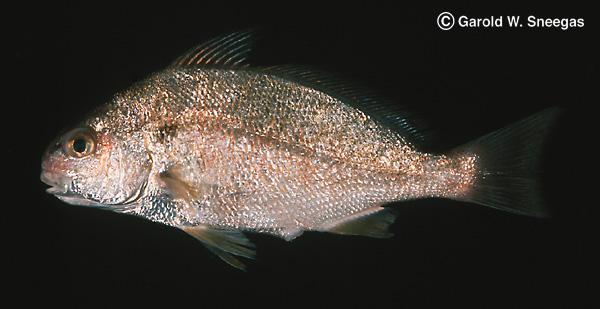


Leiostomus xanthurus
Taxonomic Hierarchy
Actinopterygii (Ray-finned Fishes)
Perciformes (Perciformes, Also Called the Acanthopteri)
Sciaenidae (Drums and Croakers)
Leiostomus
Leiostomus xanthurus (Spot)
Description
This species account was compiled from
Composite (multiple sources) (McEachran, J.D. and J.D. Fechhelm. Fishes of the Gulf of Mexico. University of Texas Press, Austin.)
and processed using AI-assisted text extraction.
It may contain errors in spelling, punctuation, or formatting.
When citing, please reference the original source rather than this page.
Learn more about our species accounts.
Characters
Relatively deep bodied, with a small, nearly horizontal mouth; dorsal profile of head elevated above eye; posterior naris slitlike and larger than anterior naris; maxilla extends to about center of pupil; snout has five marginal and five rostral pores; chin has about five mental pores; jaw teeth villiform and arranged in bands; preopercular margin membranous; gill rakers on first arch moderately short and slender, 8 to 12 on upper limb and 20 to 24 on lower limb; measurements (% SL): head length 29%–32%, snout length 7%–9%, eye length 7%–8%, upper jaw length 10%–11%, pectoral fin length 27%–31%, body depth 32%–36%; pectoral fin has 19 to 24 rays; dorsal fin deeply notched, with 9 to 11 spines in anterior section and 1 spine and 29 to 35 rays in posterior section; anal fin has 2 spines and 12 or 13 rays; caudal fin concave; body and most of head covered with ctenoid scales; basal parts of rayed sections of dorsal and anal fins scaled; gas bladder simple and carrot shaped, lacking appendages
Silvery gray, darker dorsally than ventrally, with 11 to 15 dark streaks extending to below lateral line and a black blotch, equal to size of iris, behind upper end of operculum; dorsal and caudal fins dusky, other fins pale or yellowish
Distribution
Western Atlantic from Massachusetts to Veracruz, possibly absent from southeastern Florida
Common in the northern and western Gulf of Mexico to Veracruz
Habitat Associations
Sandy or muddy bottoms from near shore to 60 m; uses estuaries as nursery grounds
Estuaries (as nursery grounds); juveniles may remain in estuaries year-round
Biology
Detritus, polychaetes, and small crustaceans
Maximum known size is 360 mm TL
Found usually over sandy or muddy bottoms in coastal waters to about 60 m depth. Occurs in nursery and feeding grounds in river estuaries during summer and fall. Juveniles often stay in the estuarine waters throughout the year. Feeds mainly on worms, small crustaceans and organic detritus. A small specimen of this species was caught in Tokyo Bay, Japan, probably brought in with the ballast water of a ship (Ref. 10325).
Reproductive mode: dioecism; fertilization: external; nonguarders (open water/substratum egg scatterers); parental care: none.
IUCN Red List Status: Least Concern (LC), assessed 2019-10-09. Resilience: High (K=0.4; tmax=4).
Commercial or Environmental Importance
Fisheries: commercial; gamefish.
References
Hastings et al. 1976
Hoese and Moore 1977
Hoese and Moore 1998
Chao 1978
Chao 2002
Johnson 1978
Robins and Ray 1986
Boschung 1992
Castro-Aguirre et al. 1999
Robins, C.R. and G.C. Ray (1986) A field guide to Atlantic coast fishes of North America. Houghton Mifflin Company, Boston, U.S.A. 354 p.
Sasaki, K., S. Hosoya and S. Watanabe (1989) Leiostomus xanthurus, a western Atlantic sciaenid species in Tokyo Bay. Jap. J. Ichthyol. 36(2):267-269.
Bowman, R.E., C.E. Stillwell, W.L. Michaels and M.D. Grosslein (2000) Food of northwest Atlantic fishes and two common species of squid. NOAA Tech. Memo. NMFS-NE 155, 138 p.
Patzner, R.A. (2008) Reproductive strategies of fish. pp. 311-350. In Rocha, M.J., A. Arukwe and B.G. Kapoor (eds). Fish reproduction: cytology, biology and ecology. Science Publisher, Inc. Oxford. 631 p.
Comments On Leiostomus xanthurus