
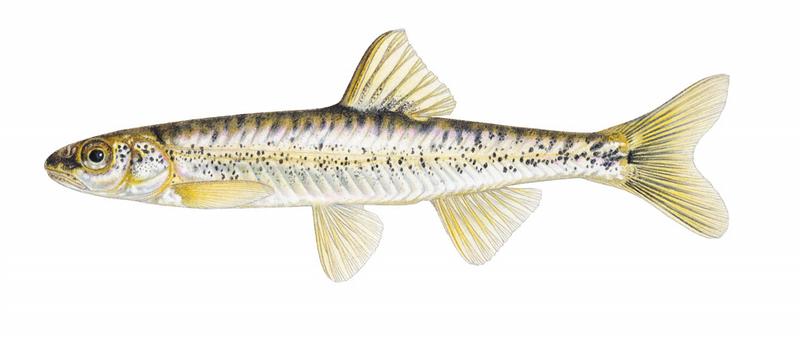
Meda fulgida
Spikedace
Federal:
Endangered
NS
G2
Taxonomic Hierarchy
Actinopterygii (Ray-finned Fishes)
Cypriniformes (Carps and Minnows)
Cyprinidae (Carps and Minnows)
Meda
Meda fulgida (Spikedace)
Description
This species account was compiled from
FishBase (Froese, R. and D. Pauly. Editors. 2025. FishBase. World Wide Web electronic publication. www.fishbase.org, version 04/2025.)
and processed using AI-assisted text extraction.
It may contain errors in spelling, punctuation, or formatting.
When citing, please reference the original source rather than this page.
Learn more about our species accounts.
Characters
Body shape: elongated. Meda fulgida can be distinguished by the following characters: anal fin with 9 rays; pharyngeal teeth 1,4-4,1; scales absent; slender body, somewhat compressed at front, strongly compressed at caudal peduncle; slightly subterminal mouth on fairly pointed snout; large eye; pelvic-fin origin before before dorsal-fin origin; olive-gray to light brown above; brilliant silver side, often with blue sheen; back and upper side with black specks and blotches; and bright brassy yellow head and fin bases, yellow belly and fins in breeding males (Ref. 86798).
Distribution
North America: Gila River system in Arizona and New Mexico, USA.
Habitat Associations
Freshwater. demersal. Found in: streams.
Biology
Inhabits sandy and rocky runs and pools and often occurs near riffles of creeks and small rivers (Ref. 86798).
Max length: 9.1 cm TL; common length: 6.3 cm TL.
Reproductive mode: dioecism; fertilization: external; nonguarders.
IUCN Red List Status: Endangered (EN), assessed 2012-04-13. Resilience: High (Preliminary K or Fecundity.).
References
Riehl, R. and H.A. Baensch (1991) Aquarien Atlas. Band. 1. Melle: Mergus, Verlag für Natur-und Heimtierkunde, Germany. 992 p.
Page, L.M. and B.M. Burr (2011) A field guide to freshwater fishes of North America north of Mexico. Boston : Houghton Mifflin Harcourt, 663p.
Comments On Meda fulgida