


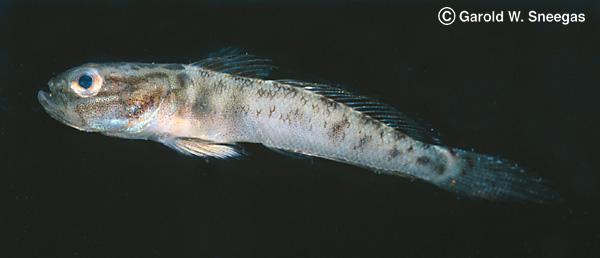

Microgobius gulosus
Taxonomic Hierarchy
Actinopterygii (Ray-finned Fishes)
Perciformes (Perciformes, Also Called the Acanthopteri)
Gobiidae (Gobies)
Microgobius
Microgobius gulosus (Clown Goby)
Description
This species account was compiled from
Composite (multiple sources) (McEachran, J.D. and J.D. Fechhelm. Fishes of the Gulf of Mexico. University of Texas Press, Austin.)
and processed using AI-assisted text extraction.
It may contain errors in spelling, punctuation, or formatting.
When citing, please reference the original source rather than this page.
Learn more about our species accounts.
Characters
Head slightly compressed and concave between orbits. Mouth terminal and moderately oblique, with lower jaw projecting beyond upper jaw and upper jaw extending slightly beyond eye in females and far beyond eye in mature males. Jaw teeth arranged in two rows, with those of outer row slightly enlarged and caniniform. Gill opening extends the length of pectoral fin base. Gill rakers on first arch number 3 on upper limb and 10 on lower limb. Measurements (% SL): head length 29%-33% in males and 26%-31% in females, snout length 7.3%-7.5% in males and 5.4%-6.8% in females, eye diameter 6.5%-7.6%, interorbital width 2.1%-2.7%, pectoral fin length 21%-28%, pelvic fin length 20.7%-26.5%, caudal fin length 31.7%-34.2% in males and 30.8%-32.5% in females, and body depth 15.4%-19.7%. Pectoral fin rays number 19 to 24 (usually 20 to 23). First dorsal fin has seven spines, and second dorsal fin has one spine and 14 to 17 (usually 14 to 16) rays. Second through sixth dorsal fin spines of mature males are greatly produced into filaments. Pelvic fins are united by membrane to form disc. Anal fin has one spine and 15 to 17 rays. Caudal fin is lanceolate. Body posterior to pectoral fin axil is covered with scales; those along lateral midline of body, on caudal peduncle, and in patch behind pectoral fin are weakly ctenoid, and the remainder are cycloid. Lateral cephalic sensory pores number two to four (usually three), and preopercular canal has two pores. Scales in horizontal series range from 44 to 54. Vertebrae number 27: 11 precaudal and 16 caudal.
Color is tan, with eight or nine dark brown blotches on upper half of body. In males, second dorsal, anal, and caudal fins have a clear stripe and dark margins. In females, body has many irregular dark blotches, and dorsal fins and upper half of caudal fin have dark spots.
Distribution
Western Atlantic from Chesapeake Bay to the southern Gulf of Mexico
Known throughout the Gulf of Mexico in shallow water
Habitat Associations
Protected water ranging from full seawater to freshwater, shallow water
Muddy to calcareous substrates
Biology
Algae, polychaetes, bivalve mollusks, copepods, and gammarid amphipods
Maximum known size is 75 mm TL
Adults inhabit mangrove streams with very fine silt-mud substrate (Ref. 92840) with salinity ranging from 0.0 to 36.6 ppt (Ref. 97140).
Reproductive mode: dioecism; fertilization: external. Benthic spawner.
IUCN Red List Status: Least Concern (LC), assessed 2010-03-01. Resilience: High (Preliminary K or Fecundity.).
References
Springer and Woodburn 1960
Hoese and Moore 1977
Hoese and Moore 1998
Castro-Aguirre 1978
Birdsong 1981
Robins and Ray 1986
Boschung 1992
Murdy et al. 1997
Smith 1997
Castro-Aguirre et al. 1999
Murdy and Hoese 2002b
Robins, C.R. and G.C. Ray (1986) A field guide to Atlantic coast fishes of North America. Houghton Mifflin Company, Boston, U.S.A. 354 p.
Cole, K.S. (1990) Patterns of gonad structure in hermaphroditic gobies (Teleostei: Gobiidae). Environ. Biol. Fishes 28(1-4):125-142.
Carr, W.E.S. and C.A. Adams (1973) Food habits of juvenile marine fishes occupying seagrass beds in the estuarine zone near crystal river, Florida. Trans. Am. Fish. Soc. 102(3):511-540.
Tornabene, L., J.L. Van Tassel and D.R. Robertson (2012) Microgobius urraca (Teleostei: Gobiidae), a new species of goby from the tropical eastern Pacific. Zootaxa 3447:41-55.
Patzner, R.A., J.L. Van Tassell, M. Kovačić and B.G. Kapoor (2011) The biology of gobies. Enfield, NH : Science Publishers ; Boca Raton, FL : DIstributed by CRC Press, 685 p.
Comments On Microgobius gulosus