
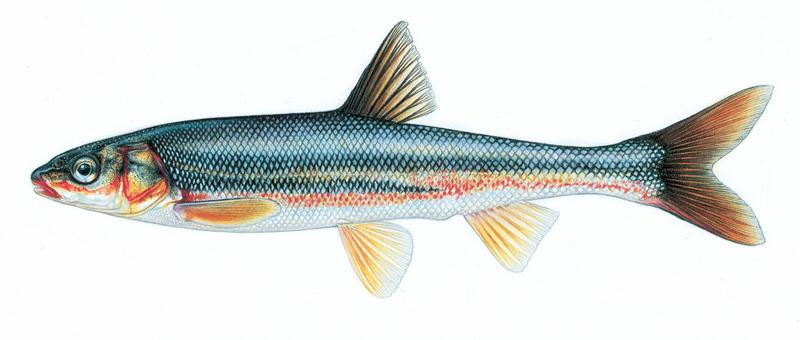
Mylocheilus caurinus
Peamouth
NS
G5
Taxonomic Hierarchy
Actinopterygii (Ray-finned Fishes)
Cypriniformes (Carps and Minnows)
Cyprinidae (Carps and Minnows)
Mylocheilus
Mylocheilus caurinus (Peamouth)
Description
This species account was compiled from
FishBase (Froese, R. and D. Pauly. Editors. 2025. FishBase. World Wide Web electronic publication. www.fishbase.org, version 04/2025.)
and processed using AI-assisted text extraction.
It may contain errors in spelling, punctuation, or formatting.
When citing, please reference the original source rather than this page.
Learn more about our species accounts.
Characters
Body shape: fusiform / normal. Lateral line complete with 66-84 scales; dorsal fin with 8 rays; anal fin with 8 rays; molarlike pharyngeal teeth 1,5--5,1; slender body, somewhat compressed; large eye; long rounded snout; barbel at corner of slightly subterminal mouth; large forked caudal fin; dorsal-fin origin over or in front of pelvic-fin origin; axillary process at pelvic-fin base; dark gray-brown to green above; 2 dark stripes, lower one ending in front of anal fin, on silver yellow side; yellow to brown fins; and large male with red on side, belly mouth, gill cover and pectoral-fin base (Ref. 86798).
Distribution
North America: Nass (Pacific Slope) and Peace River (Arctic basin) systems in British Columbia, Canada south to Columbia River drainage in Oregon and Idaho, USA; also in Vancouver, British Columbia and Mackenzie River drainage (Arctic basin) in Northwest Territories, Canada (Ref. 86798). Sometimes occurs at Spanish Banks (Ref. 4569).
Habitat Associations
Freshwater, brackish. demersal. Found in: streams, lakes.
Biology
Inhabits lakes and slow-flowing areas of small to medium rivers. Common around vegetation (Ref. 86798). Forms schools. Can withstand brackish waters for a limited period (Ref. 1998). Newly hatched individuals school near the shore, moving into deeper water in the summer (Ref. 4569). Feeds mainly on aquatic insects and its larvae and some terrestrial insects (Ref. 10288); but also on planktonic crustaceans, mollusks, and small fishes (Ref. 1998). Preyed upon by fish-eating birds and mammals (Ref. 1998). Utilized as game fish and as food in the past (Ref. 1998).
Max length: 36.0 cm TL; common length: 19.8 cm SL.
Reproductive mode: dioecism; fertilization: external; mating system: polyandry; nonguarders (open water/substratum egg scatterers); parental care: none. Spawning fish come close to shore in groups of 50-400. Groups are about 25 to 100 feet apart from each other. Females are crowded by 2 or more males into 1 or 2 inches of water by the shoreline and eggs and sperms are released.
IUCN Red List Status: Least Concern (LC), assessed 2012-03-01. Resilience: Medium (tm=4).
Commercial or Environmental Importance
Fisheries: commercial; aquarium: public aquariums.
References
Scott, W.B. and E.J. Crossman (1973) Freshwater fishes of Canada. Bull. Fish. Res. Board Can. 184: xi+1-966.
Coker, G.A., C.B. Portt and C.K. Minns (2001) Morphological and ecological characteristics of Canadian freshwater fishes. Can. MS Rpt. Fish. Aquat. Sci. 2554:iv+89p.
Page, L.M. and B.M. Burr (2011) A field guide to freshwater fishes of North America north of Mexico. Boston : Houghton Mifflin Harcourt, 663p.
Comments On Mylocheilus caurinus