
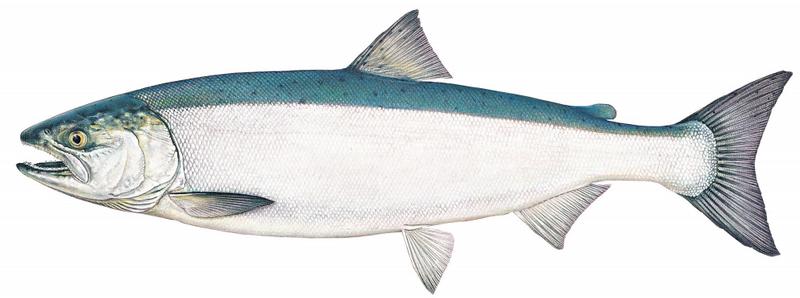
Oncorhynchus kisutch
Coho Salmon
NS
G5
Taxonomic Hierarchy
Actinopterygii (Ray-finned Fishes)
Salmoniformes
Salmonidae (Trouts and Salmons)
Oncorhynchus
Oncorhynchus kisutch (Coho Salmon)
Description
This species account was compiled from
FishBase (Froese, R. and D. Pauly. Editors. 2025. FishBase. World Wide Web electronic publication. www.fishbase.org, version 04/2025.)
and processed using AI-assisted text extraction.
It may contain errors in spelling, punctuation, or formatting.
When citing, please reference the original source rather than this page.
Learn more about our species accounts.
Characters
Body shape: fusiform / normal. Characterized by the presence of small black spots on the back and on the upper lobe of the caudal fin, and by the lack of dark pigment along the gum line of the lower jaw (Ref. 27547). The gill rakers are rough and widely spaced; the lateral line is nearly straight (Ref. 27547). The adipose fin is slender; the pelvic fins have an axillary extension (Ref. 27547). Fish in the sea are dark metallic blue or greenish on the back and upper sides, a brilliant silver color on middle and lower sides, and white below; small black spots are present on the back and upper sides and on the upper lobe of the caudal fin (Ref. 27547). During the spawning season fish turn dark to bright green on head and back, bright red on the sides, and often dark on the belly (Ref. 27547). Females are less brightly colored than males (Ref. 27547).
Distribution
North Pacific: distributed from the Anadyr River in Russia south towards Hokkaido, Japan, and from Point Hope in Alaska southwards to Chamalu Bay in Baja California, Mexico.
Habitat Associations
Freshwater, brackish, marine. pelagic-neritic. depth range 0-250 m. Found in: streams, lakes, estuaries.
Biology
The fish occur in the ocean or in lakes; adults return to the rivers where they were born (Ref. 27547). The young fish emerge in springtime and they usually live in fresh water for 1-2 years (sometimes up to 4 years, Ref. 27547); later they migrate at night to freshwater lakes or to the sea (Ref. 1998). Epipelagic (Ref. 58426). The fish that stay more than two years in fresh water and become sexually ripe without ever going to sea, are called residuals; they never spawn (Ref. 27547). Young fish in lakes and rivers eat mainly insects; they stay almost entirely in deep parts of the river and soon become strongly territorial (Ref. 27547). Upon reaching the sea, the smolts remain close to the coast for a certain time, eating planktonic crustaceans (Ref. 27547). As they grow, they migrate farther out into the sea and hunt larger organisms (Ref. 27547) such as jellyfish, squids and fishes (Ref. 58426). They are hunted by various fishes, birds (mergansers, loons and kingfishers), mammals and lampreys (Ref. 1998). This kind is traded as fresh fish, dried or salted, smoked, canned, preserved and frozen (Ref. 9988). They are steamed, grilled, broiled, cooked in the microwave and baked (Ref. 9988).
Max length: 107.9 cm TL; common length: 71.0 cm TL; max weight: 15170 g; max age: 5 years.
Reproductive mode: dioecism; fertilization: external; nonguarders (brood hiders); parental care: maternal. Adults migrate from the sea or lake, school at mouths of rivers, and move upstream when rains increase river flow (Ref. 1998). As a rule, the winter entries (December and January) occur in the southern part of the range, with appearance in fresh water becoming progressively earlier to the north (Ref. 30381, 30382, 30383). At the spawning area, the female finds a spot and digs a pitt. At this point she is aggressive toward other females. While digging, an attendant male courts her or is busy driving away other males. As soon as the pitt is completed, the female drops into it and is immediately followed by the male. The pair are side by side, they open their mouth, quiver and release egg and sperm (Ref. 27547). At this point, other males move in and release sperm into the nest (Ref. 1998). The female quickly moves to the upstream edge of the nest and starts digging a new pitt, covering the eggs. The whole process is repeated for several days until the female deposits all her eggs. The male then leaves and may seek another female. The spent female usually continues to dig, until she dies (Ref. 27547).
Reproductive strategy: synchronous ovarian organization, determinate fecundity (Ref. 51846).
IUCN Red List Status: Least Concern (LC), assessed 2020-07-27. Resilience: Medium (K=0.98(?); tm=2-4; Fec=1,400).
Commercial or Environmental Importance
Fisheries: highly commercial; gamefish; aquaculture: commercial.
References
Scott, W.B. and E.J. Crossman (1973) Freshwater fishes of Canada. Bull. Fish. Res. Board Can. 184: xi+1-966.
Eschmeyer, W.N., E.S. Herald and H. Hammann (1983) A field guide to Pacific coast fishes of North America. Boston (MA, USA): Houghton Mifflin Company. xii+336 p.
Hart, J.L. (1973) Pacific fishes of Canada. Bull. Fish. Res. Board Can. 180:740 p.
Brodeur, R.D. (1991) Ontogenetic variations in the type and size of prey consumed by juvenile coho, Oncorhynchus kisutch, and chinook, O. tshawytscha, salmon. Environ. Biol. Fishes 30(3):303-315.
Morrow, J.E. (1980) The freshwater fishes of Alaska. University of. B.C. Animal Resources Ecology Library. 248p.
IGFA (2001) Database of IGFA angling records until 2001. IGFA, Fort Lauderdale, USA.
Fedorov, V.V., I.A. Chereshnev, M.V. Nazarkin, A.V. Shestakov and V.V. Volobuev (2003) Catalog of marine and freswater fishes of the northern part of the Sea of Okhotsk. Vladivostok: Dalnauka, 2003. 204 p.
Coker, G.A., C.B. Portt and C.K. Minns (2001) Morphological and ecological characteristics of Canadian freshwater fishes. Can. MS Rpt. Fish. Aquat. Sci. 2554:iv+89p.
Page, L.M. and B.M. Burr (2011) A field guide to freshwater fishes of North America north of Mexico. Boston : Houghton Mifflin Harcourt, 663p.
Teletchea, F., A. Fostier, E. Kamler, J-N. Gardeur, P-Y. Le Bail, B. Jalabert and P. Fontaine (2009) Comparative analysis of reproductive traits in 65 freshwater fish species: application to the domestication of new fish species. Rev. Fish Biol. Fish. 19:403-430.
Comments On Oncorhynchus kisutch