

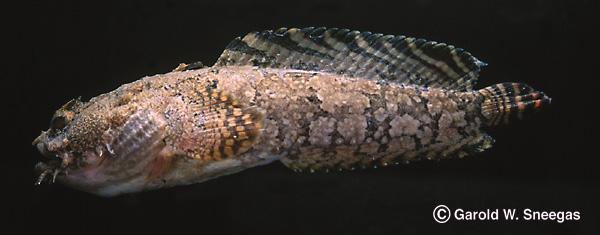
Opsanus beta
Gulf Toadfish
NS
G5
Taxonomic Hierarchy
Actinopterygii (Ray-finned Fishes)
Batrachoidiformes
Batrachoididae (Toadfishes)
Opsanus
Opsanus beta (Gulf Toadfish)
Description
This species account was compiled from
Composite (multiple sources) (McEachran, J.D. and J.D. Fechhelm. Fishes of the Gulf of Mexico. University of Texas Press, Austin.)
and processed using AI-assisted text extraction.
It may contain errors in spelling, punctuation, or formatting.
When citing, please reference the original source rather than this page.
Learn more about our species accounts.
Characters
Moderately compressed anteriorly and depressed posteriorly, with axillary pore behind pectoral fin base and gland on inner surface of upper membrane of pectoral fin. Head has tentacles over inner margin of eye; fleshy tabs along lower jaw; and blunt, flattened maxillary barbel. Lower jaw extends slightly beyond upper jaw, and mouth is moderately oblique. Jaws, vomer, and palatine have narrow bands of moderately blunt and moderate-sized teeth; canine teeth are lacking in jaws. Head length is 31% to 31.9%, head width is 26.7% to 27%, orbit diameter is 5.2% to 6.2%, interorbital width is 3.3% to 4.3%, snout to second dorsal fin is 41.3% to 45.1%, snout to anal fin origin is 54.2% to 56.3%, pectoral fin length is 22% to 22.3%, and pelvic fin length is 14.7% to 17.5% of SL. Operculum has two solid, sharp spines; sub-operculum has single sharp spine; and all spines may be hidden in skin. Pectoral fin has 18 or 19 rays. First dorsal fin has three short, solid spines. Second dorsal fin has 24 or 25 rays. Anal fin has 19 to 23 rays. Body lacks scales and has three lateral lines.
Color is brown to grayish brown, marbled and mottled with tan to white. Pale areas on body often form rosettes posteriorly. Dorsal and anal fins are diagonally barred, and pectoral fin has light-colored spots and blotches on dark background.
Distribution
Western Atlantic from southeastern Florida, south of Cape Canaveral, to the Gulf of Mexico and the Bahamas
Habitat Associations
Shallow coastal waters
Seagrass beds, bays, lagoons, and shallow coastal areas
Biology
Maximum known size is 300 mm TL
Commonly found in seagrass beds and rocky cuts in coastal bays and lagoons, and in shallows along open coast. In western coast of Florida, adults spawn in February and March (Ref. 26938). Nesting males produce grunt calls called the boatwhistle as advertisement of competition among males and to attract females (Ref. 45338). Neither opercular nor dorsal gland is venomous (Ref. 57406).
Reproductive mode: dioecism; fertilization: external; mating system: polygyny; guarders (nesters); parental care: paternal.
IUCN Red List Status: Least Concern (LC), assessed 2018-11-23. Resilience: Medium (K=0.218; tm=1+).
Phylogeny and Morphologically Similar Fishes
Distinguished from other species of the family by the combination of characters described
References
Schultz and Reid 1937
Bohlke and Chaplin 1968
Hoese and Moore 1977
C. R. Robins et al. 1986
Boschung 1992
Robins, C.R. and G.C. Ray (1986) A field guide to Atlantic coast fishes of North America. Houghton Mifflin Company, Boston, U.S.A. 354 p.
Smith, C.L. (1997) National Audubon Society field guide to tropical marine fishes of the Caribbean, the Gulf of Mexico, Florida, the Bahamas, and Bermuda. Alfred A. Knopf, Inc., New York. 720 p.
Yáñes-Arancibia, A., A.L. Lara-Domínguez and J.W. Day Jr. (1993) Interactions between mangrove and seagrass habitats mediated by estuarine nekton assemblages: coupling of primary and secondary production. Hydrobiologia 264:1-12.
Thorson, R.F. and M.L. Fine (2002) Crepuscular changes in emission rate and parameters of the boatwhistle advertisement call of the gulf toadfish, Opsanus beta. Environ. Biol. Fishes 63:321-331.
Malca, E., J.F. Barimo, J.E. Serafy and P.J. Walsh (2009) Age and growth of the gulf toadfish Opsanus beta based on otolith increment analysis. J. Fish Biol. 75(8):1750-1761. DOI: 10.1111/j.1095-8649.2009.02426.x
Comments On Opsanus beta