
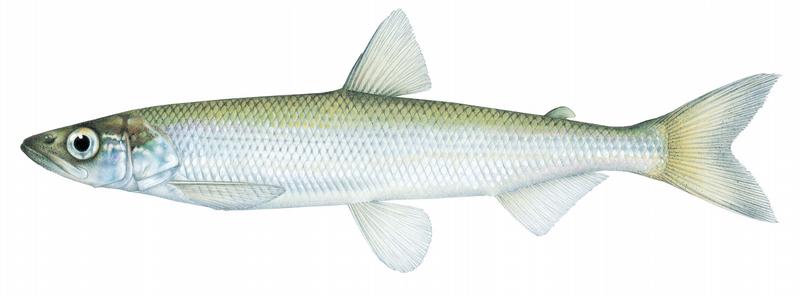
Osmerus mordax
Rainbow Smelt
NS
G5
Taxonomic Hierarchy
Actinopterygii (Ray-finned Fishes)
Salmoniformes
Osmeridae (Smelts)
Osmerus
Osmerus mordax (Rainbow Smelt)
Description
This species account was compiled from
FishBase (Froese, R. and D. Pauly. Editors. 2025. FishBase. World Wide Web electronic publication. www.fishbase.org, version 04/2025.)
and processed using AI-assisted text extraction.
It may contain errors in spelling, punctuation, or formatting.
When citing, please reference the original source rather than this page.
Learn more about our species accounts.
Characters
Body shape: elongated. Body elongate, laterally compressed, greatest depth at anterior of dorsal fin origin. Head moderate; eye moderately large; snout elongate, pointed. Mouth large; lower jaw protruding, maxillary extending to middle of eye or beyond, well toothed on vomer, palatine, pterygoid, basibranchial, dentary, maxillary, and tongue. Teeth specially enlarged on tongue and front of vomer. Body color is pale green on back, with purple, blue, and pink iridescent reflections on the side when freshly caught. Striking features: none.
Distribution
North Atlantic: Atlantic drainages from Lake Melville in Newfoundland and Labrador, Canada to Delaware River in Pennsylvania, USA and west through Great lakes. Arctic and Pacific drainages from Bathurst Inlet, Northwest Territories to Vancouver Island in British Columbia, Canada. Also Pacific drainages of Asia.
Habitat Associations
Freshwater, brackish, marine. pelagic-oceanic. depth range 0-425 m. Found in: streams, lakes, estuaries.
Biology
Nerito-pelagic (Ref. 58426). Inhabits cool clear lakes, medium to large rivers, and coastal waters (Ref. 86798). A schooling species that occurs in midwater of lakes or inshore coastal waters (Ref. 1998); at temperatures ranging from 7.2-15.6°C. Coastal population are anadromous (Ref, 86798). Migrates up to 1,000 km upstream in rivers (Ref. 6793). Occurs possibly to 425 m (Ref. 2851). Feeds on invertebrates such as amphipods, ostracods, aquatic insect larvae and aquatic worms (Ref. 1998); food also include copepods, euphausiids, mysids and small fishes (silversides, mummichogs and herring) (Ref. 5951, 10294). Headed, gutted, sold fresh, frozen and precooked. Eaten sautéed and fried (Ref. 9988).
Max length: 35.6 cm TL; max age: 7 years.
Reproductive mode: dioecism; fertilization: external; nonguarders (open water/substratum egg scatterers); parental care: none. Spawning runs occur when temperature is between 8.9-18.3°C, may last for 3 weeks, peak for 1 week. Lengths of both sexes decrease as spawning progress. Two or more tuberculated males maintain position against a female in swift water, eggs released in clusters and presumably milt released simultaneously. Spawning usually takes place at night, spawners move downstream to the lake during daytime.
IUCN Red List Status: Least Concern (LC), assessed 2012-03-01. Resilience: Medium (K=0.31; tm=2-6; tmax=6; Fec=8,500).
Commercial or Environmental Importance
Fisheries: commercial; gamefish.
References
Scott, W.B. and E.J. Crossman (1973) Freshwater fishes of Canada. Bull. Fish. Res. Board Can. 184: xi+1-966.
Mills, E.L., R. O'Gorman, E.F. Roseman, C. Adams and R.W. Owens (1995) Planktivory by alewife (Alosa pseudoharengus) and rainbow smelt (Osmerus mordax) on microcrustacean zooplankton and dreissenid (Bivalvia: Dreissenidae) veligers in southern Lake Ontario. Can. J. Fish. Aquat. Sci. 52:925-935.
Balon, E.K. (1975) Reproductive guilds of fishes: a proposal and definition. J. Fish. Res. Board Can. 32(6):821-864.
Coad, B.W. and J.D. Reist (2004) Annotated list of the arctic marine fishes of Canada. Can. MS Rep. Fish Aquat. Sci. 2674:iv:+112 p.
Page, L.M. and B.M. Burr (2011) A field guide to freshwater fishes of North America north of Mexico. Boston : Houghton Mifflin Harcourt, 663p.
Mecklenburg, K.C., P.R. Møller and D. Steinke (2011) Biodiversity of the Arctic marine fishes: taxonomy and zoogeography. Marine Biodiversity 41(1):109-140.
Comments On Osmerus mordax