
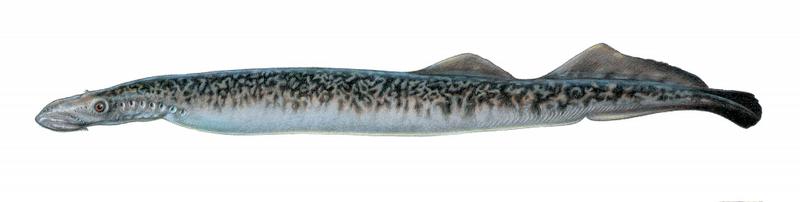
Petromyzon marinus
Sea Lamprey
NS
G5
Taxonomic Hierarchy
Cephalaspidomorphi (Lampreys)
Petromyzontiformes (Lampreys)
Petromyzontidae (Lampreys)
Petromyzon
Petromyzon marinus (Sea Lamprey)
Description
This species account was compiled from
Composite (multiple sources) (McEachran, J.D. and J.D. Fechhelm. Fishes of the Gulf of Mexico. University of Texas Press, Austin.)
and processed using AI-assisted text extraction.
It may contain errors in spelling, punctuation, or formatting.
When citing, please reference the original source rather than this page.
Learn more about our species accounts.
Characters
Elongate and posteriorly compressed, with teeth on oral disc arranged in curvilinear rows and with two dorsal fins. Inner series of teeth on oral disc are largest. Oral plate above mouth is small and has two teeth, and oral plate below mouth is broad and has seven to nine conical teeth. Tongue has three denticulated plates, with margin of anterior plate deeply indented along midline and with tooth margins concave on each side. Nostril is surrounded by circular rim and is opposite anterior margin of eye. Gill openings are round to slightly oval, about one-half diameter of eye, and evenly spaced. Distance from mouth to last gill opening is about 20% of TL. Origin of first dorsal fin is slightly posterior to mid-length of trunk, and base length is about equal to one-half head length. Second dorsal fin is separated from first by distance equal to one-third or less length of first dorsal fin, and second dorsal fin is about 2 times length of first dorsal fin. Second dorsal fin is distinguished from caudal fin by deep notch, although fins are continuous.
Color is olive-brown, yellow-brown, green, red, or blue, and generally mottled with darker shades of ground color dorsally, and whitish, gray, or a lighter shade of dorsal color ventrally. Small, recently metamorphosed specimens are blackish blue or lead colored dorsally and white ventrally.
Distribution
In the western Atlantic it occurs from the Gulf of St. Lawrence to northern Florida and in the eastern Gulf of Mexico.
Habitat Associations
Temperate waters of the North Atlantic. Anadromous, leaving freshwater upon undergoing metamorphosis.
Reported from a tidal pond near Cape San Bias, Florida in the Gulf of Mexico.
Biology
Feed on the blood of other fishes. They attach to the side of their host by means of their sucking disc and rasp through scales and skin with their tooth-bearing tongues.
Maximum known size is about 880 mm TL, and size at metamorphosis is between 100 and 200 mm TL.
Upon reaching maturity the lamprey migrates to freshwater to spawn.
Some populations are permanent freshwater residents [Laurentian Great Lakes, Finger Lakes (Lake Cayuga), Lake Champlain], while others are anadromous. Occupies a wide range of streams and habitats. Larvae are found in streams with summer flows 0.03-4,400 m3/s and summer water temperatures 10-26.1 °C. Relatively abundant in cool, pool-riffle streams with sand-gravel substrate, high water quality and stable flows, but is also tolerant of fluctuating flows. In Michigan, ammocoetes have been reported in lentic habitats up to 450 m from the presumed originating stream, at water depths 1-16 m, where substrates vary from sand-silt, with or without detritus, to gravel-rubble-sand. Feeding adults of permanent freshwater populations can be found in small to large lakes and large rivers and, in the case of anadromous populations, in small to large rivers and in the ocean. In the ocean, it occurs both pelagically and benthically, possibly to a depth of 4,099 m. Spawning adults can be found in creeks or lake inlets (Ref. 89241). Amphihaline species making important migrations. Spends its adult life in the sea for about 20-36 months, moving further offshore as it grows (Ref. 59043). Adults are parasitic, using their sharp teeth to attach themselves to cetaceans and large fish and feed off their host’s blood, body fluids and flesh for several days, usually without killing the host (Ref. 59043). An anticoagulant substance prevents the blood of the prey from clotting. Mature adults enter rivers and streams to spawn in spring (Ref. 12324, 35387, 88186). Movements from the sea to spawning sites may cover distances from 20-850 km inland (Ref. 12324). After spawning adults normally die (Ref. 51442). Ammocoetes drift downstream and bury in detritus-rich mud, silt or sand-silt bottoms (Ref. 59043, 88712) for 5.5-8 years, often at the edges of rivers and streams where currents are slow (Ref. 58185, 59043, 88184). Duration of larval life is usually a minimum of 5 yrs, but has been reported as short as 2 years and as long as 19 or more years (Ref. 89241). Ammocoetes are filter feeders of diatoms and detritus (Ref. 30578, 51442, 59043). Upon metamorphosis, individuals move downstream towards the sea. Juveniles remain in the estuaries and shallow coastal areas for a feeding period lasting 23-28 months, during which they grow from ca. 4 to 900 g (Ref. 58185, 88171). Most individuals attain 60-75 cm length (Ref. 88187). Duration of adult life in anadromous populations approximately two years. Metamorphosis occurs in July-October, but has been reported as early as April, in Michigan. Adults are parasitic on marine and freshwater fishes, and marine mammals. Multiple attachments can occur (e.g., 3 on Cetorhinus maximus, 2-3 on Urophycis chuss). Adults are preyed upon by Porbeagle Sharks in northwestern Atlantic waters. Feeding migrations in landlocked parasitic adults in the Laurentian Great Lakes can reach 628 km (Ref. 89241). They may not only feed on dead or netted fish, but also attach themselves to healthy fish. The landlocked form is very destructive to freshwater fishes and occasionally annoys bathers by clinging to them (Ref. 51442). In Michigan, the spawning period is from 27 May to 2 September, at water temperatures between 11.1-26.1 °C, with peak spawning activity in late May to mid-June. In Ontario, nest building occurs from 4 to 21 June at water temperatures 18-23 °C. In Québec and New York streams spawning also occurs in June, but in New York lakes spawning is from the end of May to the beginning of July. Nests are built in streams having 1.5-43 m width, 15-90 cm depth, and 0.01-54 m3/s flow. Up to ten spawning lampreys have been found in a nest. Fecundity, 43,997-101,932 [up to 108,000 according to Gage (1928)] eggs/female in landlocked populations and 151,836-304,832 eggs/female in anadromous populations. There are reported occurrences in Michigan of communal spawning of Sea Lamprey with Chestnut Lamprey (Pine, Platte, and Muskegon rivers), of Sea Lamprey with Northern Brook Lamprey (Devils River), of Sea Lamprey with Silver Lamprey (Carp Lake, Devils, East Au Gres, and Rifle rivers), of Sea Lamprey with American Brook Lamprey (Carp Lake, Pine and Pentwater rivers), of Sea Lamprey with American Brook Lamprey and Chestnut Lamprey (Betsie River), and of Sea Lamprey with American Brook Lamprey and Silver Lamprey (Carp Lake). Invaded the upper Laurentian Great Lakes (Huron-Michigan-Superior) in the late 1930s, where it contributed to some extent to the collapse of the Lake Trout and various cisco (Coregonus johannae, C. nigripinnis, and C. zenithicus) fisheries. The fishes that did not die directly from the lamprey attacks or indirectly from secondary fungal infection had reduced market value because of the unsightly wounds. Splake, a fast-growing hybrid between Brook Trout and Lake Trout was developed specifically in response to the effect of Sea Lamprey on Lake Trout. Overfishing was also a major consideration in the demise of Lake Trout populations and Gilbertson (1992) has suggested that another contributing factor would be the extreme sensitivity of eggs and sac fry of this species to a persistent dioxin-like PCB isomer that was probably present in the Great Lakes by the 1930s and resulted in its reduced reproductive success. Sea Lamprey has been targeted by control measures in the Laurentian Great Lakes’ Basin that include lampricide treatments (3-trifluoromethyl-4-nitrophenol, abbreviated as TFM, with or without the synergist 2’,5-dichloro-4’-nitrosalicylanilide, abbreviated as Bayer 73) aimed at ammocoetes, beginning in 1957, electromechanical barriers that intercept upstream migrants, beginning before 1957, and later low-head barriers, adjustable-crest barriers, also known as inflatable barriers, traps, and chemosterilization of males. Approximately 258,000 adult Sea Lamprey, were taken between 1953 and 1960 at electrical barriers operated in Lake Superior Basin alone. Between 1958 and 1980, 54.5 million Canadian dollars where spent for Sea Lamprey control and research. Despite some attempts at developing a fishery oriented towards ethnic communities in large cities around the Great Lakes such as Toronto, a fishery for landlocked Sea Lamprey has not become established. Additionally, high levels of mercury in adults preclude their use for human consumption. Historical fisheries for the anadromous form existed in the 1800s on the Merrimack and Connecticut rivers, Massachusetts, when it was abundant, before dams and pollution. Such fisheries have existed for centuries in Europe [England (UK), France, Portugal]. Recipes include Lamproie à la bordelaise, which involves cooking in red wine. There are reports of intoxication through eating this species (Halstead, 1967) (Ref. 89241).
IUCN Red List Status: Least Concern (LC), assessed 2022-05-29. Resilience: Low (tmax=11; K 0.16; tm=5-12; Relative Fec = 233).
Phylogeny and Morphologically Similar Fishes
Distinguished from the other species of the family by the combination of characters described.
Commercial or Environmental Importance
Fisheries: minor commercial.
References
Bigelow and Schroeder 1948a
Bigelow and Schroeder 1953b
C. R. Robins et al. 1986
Vladykov and Kott 1980
Vladykov, V.D. (1984) Petromyzonidae. p. 64-67. In P.J.P. Whitehead, M.-L. Bauchot, J.-C. Hureau, J. Nielsen, and E. Tortonese (eds.) Fishes of the north-eastern Atlantic and Mediterranean. UNESCO, Paris. vol. 1.
Bristow, P. (1992) The illustrated encyclopedia of fishes. Chancellor Press, London. 303 p.
Maitland, P.S. and R.N. Campbell (1992) Freshwater fishes of the British Isles. HarperCollins Publishers, London.368 p.
Hardisty, M.W. (1986) Petromyzon marinus (Linnaeus 1758). p. 94-116. In J. Holcík (ed.) The Freshwater fishes of Europe. Vol. 1, Part 1. Petromyzontiformes.
Farmer, J.G. (1980) Biology and physiology of feeding in adult lampreys. Can. J. Fish. Aquat. Sci. 37:1751-1761.
Haedrich, R.L. (1977) A sea lamprey from the deep ocean. Copeia 1977(4):767-768.
Rochard, E. and P. Elie (1994) La macrofaune aquatique de l'estuaire de la Gironde. Contribution au livre blanc de l'Agence de l'Eau Adour Garonne. p. 1-56. In J.-L. Mauvais and J.-F. Guillaud (eds.) État des connaissances sur l'estuaire de la Gironde. Agence de l'Eau Adour-Garonne, Éditions Bergeret, Bordeaux, France. 115 p.
Page, L.M. and B.M. Burr (2011) A field guide to freshwater fishes of North America north of Mexico. Boston : Houghton Mifflin Harcourt, 663p.
Comments On Petromyzon marinus