
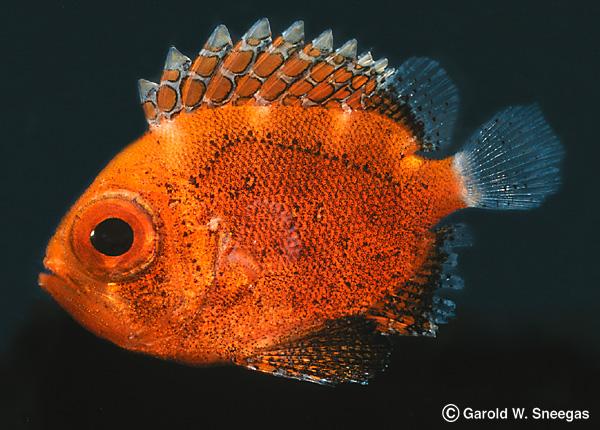
Pristigenys alta
Short Bigeye
Taxonomic Hierarchy
Actinopterygii (Ray-finned Fishes)
Perciformes (Perciformes, Also Called the Acanthopteri)
Priacanthidae (Bigeyes)
Pristigenys
Pristigenys alta (Short Bigeye)
Description
This species account was compiled from
Composite (multiple sources) (McEachran, J.D. and J.D. Fechhelm. Fishes of the Gulf of Mexico. University of Texas Press, Austin.)
and processed using AI-assisted text extraction.
It may contain errors in spelling, punctuation, or formatting.
When citing, please reference the original source rather than this page.
Learn more about our species accounts.
Characters
Broadly ovate in profile, deep bodied, and relatively robust, with scales on head highly modified and covered with spines, scales on posterior margin of preoperculum. Upper jaw teeth are small and number 180 to 200, lower jaw teeth number 70 to 75, vomerine teeth number 90 to 100, and palatine teeth number 90 to over 100. Lachrymal and second infraorbital bones have coarse serrations and spines on anteroventral margin. Premaxilla is serrated, and spine at corner occurs in juveniles and is vestigial in adults. Gill rakers on first arch number 24 to 28, with 7 or 8 on upper limb and 17 to 20 on lower limb. Measurements are expressed as percent of SL: head length 36%–41%, head depth 41%–42%, orbit diameter 20%–22%, interorbital width 6%–10%, snout length 9%–10%, lower jaw length 22%–26%, body depth 48%–63%, caudal peduncle depth 11%–13%. Pectoral fin is broadly pointed and shorter than pelvic spine length and has 16 or 19 rays. Margin of spinous section of dorsal fin is rounded and has 10 spines. Rayed sections of dorsal fin and anal fin have pointed posterodorsal margins and have 11 or 12 and 10 or 11 rays, respectively. Pelvic fin generally extends to anal fin origin in juveniles and nearly reaches origin in adults. Caudal fin has slightly rounded posterior margin, with acute upper and lower corners. Scales in horizontal series number 42 to 45. Lateral line scales number 36 to 40. Head scales, especially on chin, gular region, and top of head, have relatively strong spinules. Scales are lacking from lips.
Color is dark red in life and pink to orange after preservation, with margins of rayed sections of dorsal and anal fins and caudal fin black. Pelagic juveniles are silvery gray, with spinous section of dorsal fin black.
Distribution
Western Atlantic from New England and Bermuda to Costa Rica, including the northern and southern Gulf of Mexico, the Bahamas, and the Greater and Lesser Antilles.
Habitat Associations
Occurs between 5 and 125 m, associated with rocks and burrows.
Rocks and burrows
Biology
Maximum known size is 261 mm SL.
Off southern Florida it spawns from mid-July through mid-September. Transformation from pelagic to benthic juvenile stages occurs between 35 and 55 mm SL.
Found on rocky bottoms between 5 (Ref. 5403) and 200 m depth, usually solitary and possibly territorial.
IUCN Red List Status: Least Concern (LC), assessed 2014-01-29. Resilience: High (Preliminary K or Fecundity.).
Commercial or Environmental Importance
Fisheries: of no interest; aquarium: commercial.
References
Longley and Hildebrand 1941 (as Pseudopriacanthus altus)
Caldwell 1962a,b
Hoese and Moore 1977, 1998
Robins and Ray 1986 (all as Pseudopriacanthus altus)
Shipp and Hopkins 1978
Starnes 1988, 2002
Boschung 1992
Schaldach et al. 1997
Smith 1997
Smith-Vaniz et al. 1999
Starnes, W.C. (1988) Revision, phylogeny and biogeographic comments on the circumtropical marine percoid fish family Priacanthidae. Bull. Mar. Sci. 43(2):117-203.
Robins, C.R. and G.C. Ray (1986) A field guide to Atlantic coast fishes of North America. Houghton Mifflin Company, Boston, U.S.A. 354 p.
Watson, W. (1996) Priacanthidae: catalufas, bigeyes. p. 900-903. In H.G. Moser (ed.) The early stages of fishes in the California Current Region. California Cooperative Oceanic Fisheries Investigations (CalCOFI) Atlas No. 33. Allen Press, Inc., Lawrence, Kansas. 1505 p.
Comments On Pristigenys alta