
Prosopium coulterii
Pygmy Whitefish
NS
G5
Taxonomic Hierarchy
Actinopterygii (Ray-finned Fishes)
Salmoniformes
Salmonidae (Trouts and Salmons)
Prosopium
Prosopium coulterii (Pygmy Whitefish)
Description
This species account was compiled from
FishBase (Froese, R. and D. Pauly. Editors. 2025. FishBase. World Wide Web electronic publication. www.fishbase.org, version 04/2025.)
and processed using AI-assisted text extraction.
It may contain errors in spelling, punctuation, or formatting.
When citing, please reference the original source rather than this page.
Learn more about our species accounts.
Characters
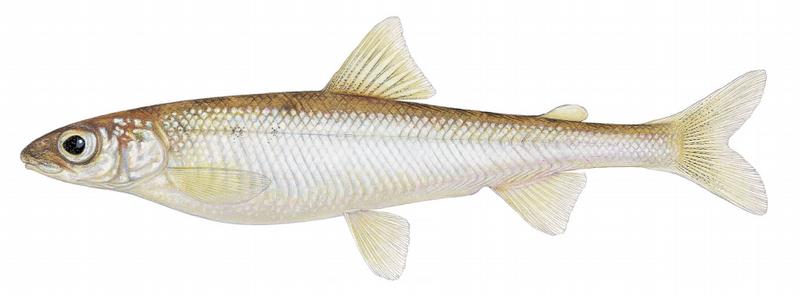
Body shape: elongated. Body elongate, almost cylindrical. Head elongate, its length slightly greater than body depth; eye relatively large, its diameter greater than snout length; snout bluntly rounded, overhanging mouth, not obviously pointed, a single flap of skin present between nostrils. Nuptial tubercles developed in both males and females, but more conspicuous in males, and occur on top of head, on scales on back and sides, and on paired fins. Body is brownish above, silvery on sides and white below. Dorsal, caudal, and pectoral fins usually clear, anal and pelvic whitish and immaculate, a faint dark spot sometimes present on base of caudal fin. A series of 12 - 14 similar spots present along the midline of the back, and 7 - 14 dark, round or oval parr marks with diffuse borders present along the lateral line of young and sub adults, although some Alaskan forms retain parr marks even on largest fish. Striking features: none.
Distribution
North America: three disjunct areas: Lake Superior in Ontario, Canada and Michigan, USA; Yukon River drainage in Yukon, Canada to Columbia River drainage in western Montana and Washington, USA; and Chignik, Naknek and Wood River drainages in southwest Alaska. Europe: Russia (Ref. 26334).
Habitat Associations
Freshwater. benthopelagic. depth range 18-168 m. Found in: streams, lakes.
Biology
Inhabits lakes and rivers of mountainous areas (Ref. 1998). Feeds mainly on crustaceans and aquatic insect larvae (Ref. 1998). Minimum depth reported from Ref. 1998.
Max length: 28.0 cm TL; common length: 11.4 cm TL; max age: 9 years.
Reproductive mode: dioecism; fertilization: external; nonguarders (open water/substratum egg scatterers); parental care: none. Moves to spawning grounds in the early winter and presumably back into deeper water after spawning. Spawns at night, presumably the eggs are broadcast, settling into interstices in the gravel. Hatching occurs the following spring (Ref. 27547).
IUCN Red List Status: Least Concern (LC), assessed 2020-09-18. Resilience: Medium (tm=1-2; tmax=9; Fec=103).
Commercial or Environmental Importance
Fisheries: of no interest; gamefish.
References
Scott, W.B. and E.J. Crossman (1973) Freshwater fishes of Canada. Bull. Fish. Res. Board Can. 184: xi+1-966.
Page, L.M. and B.M. Burr (1991) A field guide to freshwater fishes of North America north of Mexico. Houghton Mifflin Company, Boston. 432 p.
Balon, E.K. (1975) Reproductive guilds of fishes: a proposal and definition. J. Fish. Res. Board Can. 32(6):821-864.
Morrow, J.E. (1980) The freshwater fishes of Alaska. University of. B.C. Animal Resources Ecology Library. 248p.
Coker, G.A., C.B. Portt and C.K. Minns (2001) Morphological and ecological characteristics of Canadian freshwater fishes. Can. MS Rpt. Fish. Aquat. Sci. 2554:iv+89p.
Comments On Prosopium coulterii