
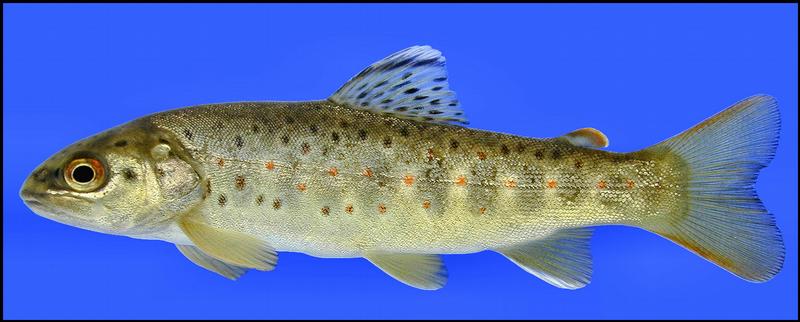
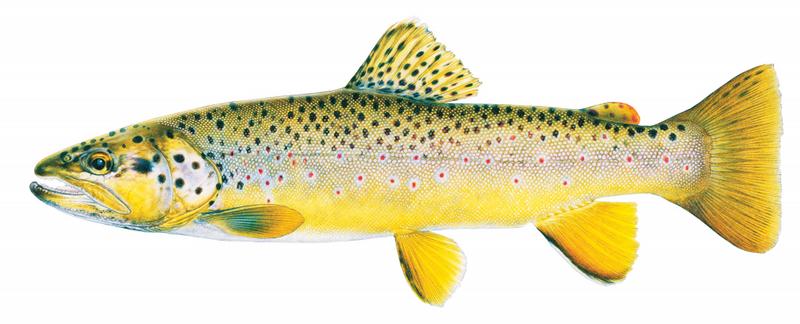
Salmo trutta
Brown Trout
Taxonomic Hierarchy
Actinopterygii (Ray-finned Fishes)
Salmoniformes
Salmonidae (Trouts and Salmons)
Salmo
Salmo trutta (Brown Trout)
Description
Type Locality
Europe (Linnaeus 1758).
Etymology
Salmo: the Latin name for salmon of the Atlantic; trutta: the Latin name for trout (Scott and Cross 1973).
Synonymy
Salmo trutta (Linnaeus 1758:308). Salmo fario (Linnaeus 1758:309). Salmo eriox (Jordan 1926:141). Salmo levenensis (Günther 1866:101).
Characters
103 cm (Fuller et al. 1999).
Red and black spots on head and body, many spots on gill cover, usually unspotted or vaguely spotted caudal fin. In streams, olive to dark brown above, silver sheen on yellow-brown side, white to yellow below; bold black spots on head, back, dorsal, and adipose fins, and extending below lateral line on side. Rust-red spots on side, usually orange or red adipose fin. Silver overall, often with X-marks above in large lakes and ocean (Page and Burr 1991).
Teeth developed on upper and lower jaws (premaxillary, maxillary, and dentary), usually many teeth on head and shaft of vomer, on palatines, on tongue in 2 rows, no hyoid teeth (Scott and Crossman 1983).
120-130 lateral scales, usually 9 dorsal rays, and 10 branchiostegal rays (Page and Burr 1991).
Typically troutlike, elongate, compressed laterally (Scott and Crossman 1973).
Terminal (Scott and Crossman 1973).
Breeding males have hooked lower jaw, rounded anal fin, and females have falcate anal fin (Page and Burr 1991).
Distribution
: Introduced from Germany (Needham 1969). Native to Europe, North Africa, and west Asia; introduced to North America in 1883 and now widely socked throughout south Canada and much of the U.S. Locally common (Page and Burr 1991). :
Habitat Associations
Most stocking have been into cool, high gradient streams and cold lakes. In streams, adults live in pools, young occupy pools and riffles. Some sea-run populations have become establishes (Page and Burr 1991).
Biology
Late autumn to early winter (Scott and Crossman 1973).
Shallow, gravelly headwaters (Scott and Crossman 1973).
Females create redds in the gravel, in which the spawning fish deposit eggs and sperm. The process in repeated many times, and then the female covers the redd with gravel (Scott and Crossman 1973).
Larger fish deposit more eggs, in Canada, females age 5 and 6 averaged 2020 eggs, usually 4-5 mm in diameter (Scott and Crossman 1973).
Phylogeny and Morphologically Similar Fishes
Atlantic Salmon have 2-3 large black spots on gill cover, no red spots on body, no red or orange on adipose fin; upper jaw reaches only to below center of eye (except in large males; Page and Burr 1991).
Host Records
Fungi (5), Protozoa (12), Trematoda (32), Cestoda (12), Nematoda (20), Acanthocephala (13), Leech (2), Mollusca (Glochidia), Crustacea (7) (Hoffman 1967).
References
Fuller, P. L., L. G. Nico, and J. D. 1999. Nonindigenous fishes introduced into inland waters of the United States. American Fisheries Society, Special Publication 27, Bethesda, Maryland 613 pp.
Hoffman, G. L. 1967. Parasites of North American Freshwater Fishes. University of California Press, Berkeley, 486 pp.
Needham, P. R. 1969. Trout streams. Holden-Day, San Francisco, Calif. 241 pp.
Page, L.M., and B. M. Burr. 1991. A Field Guide to Freshwater Fishes of North America, north of Mexico. Houghton Mifflin Company, Boston, 432 pp.
Comments On Salmo trutta