
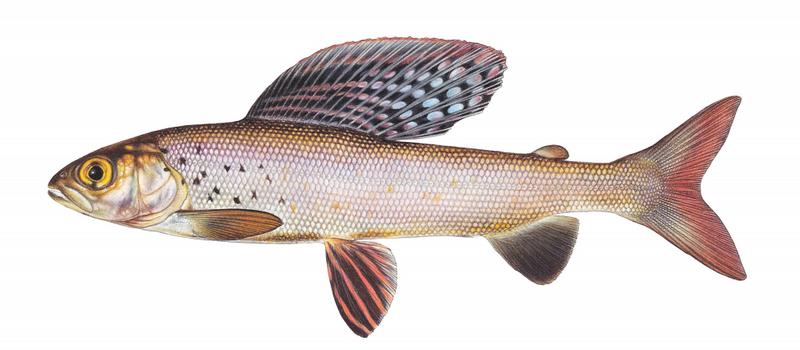
Thymallus arcticus
Arctic Grayling
NS
G5
Taxonomic Hierarchy
Actinopterygii (Ray-finned Fishes)
Salmoniformes
Salmonidae (Trouts and Salmons)
Thymallus
Thymallus arcticus (Arctic Grayling)
Description
This species account was compiled from
FishBase (Froese, R. and D. Pauly. Editors. 2025. FishBase. World Wide Web electronic publication. www.fishbase.org, version 04/2025.)
and processed using AI-assisted text extraction.
It may contain errors in spelling, punctuation, or formatting.
When citing, please reference the original source rather than this page.
Learn more about our species accounts.
Characters
Body shape: fusiform / normal. Distinguished by its greatly enlarged dorsal fin and its small mouth, which has fine teeth on both jaws (Ref. 27547). Dorsal greatly enlarged in adults (especially males), reaching adipose fin when depressed, but is shorter in females; pelvic fins rather long, reach anal fin in adult males, but not in females; lower lobe of caudal often longer than upper (Ref. 27547). A strikingly colored fish, the dorsal surface is dark purple, or blue black to blue gray, the sides gray to dark blue with pinkish iridescence, the ventral surface gray to white (Ref. 1998). Scattered dark spots on sides, these being more numerous on the young; a dark longitudinal stripe along lower sides between pectoral and pelvic fins; dorsal fin dark with narrow purple edge (rows of reddish to orange or purple to green spots on body of fin); pelvic fins dark with irregular diagonal orange-yellow stripes; adipose, dorsal, anal, caudal and pectorals dusky to dark (Ref. 27547). Striking features: none.
Distribution
North America: widespread in Arctic drainages from Hudson Bay, Canada to Alaska and in Arctic and Pacific drainages to central Alberta and British Columbia in Canada; upper Missouri River drainage in Montana, USA. Formerly in Great Lakes basin in Michigan, USA (Ref. 5723). Arctic Ocean basin in Siberia from Ob to Yenisei drainages and in Europe in some tributaries of Pechora (Usa, Kosyu, Kozhim), Korotaikha and Kara (Ref. 59043).
Habitat Associations
Freshwater. benthopelagic. Found in: streams, lakes.
Biology
Inhabits open water of clear, cold, medium to large rivers and lakes. Enters rocky creeks to spawn (Ref. 5723). Occurs in piedmont and montane cold streams, rivers and lakes with high oxygen concentrations (Ref. 59043). Forms schools in moderate numbers (Ref. 9988). Young feed on zooplankton with a gradual shift to immature insects; adults feed mainly on surface insects but also take in fishes, fish eggs, lemmings, and planktonic crustaceans (Ref. 1998). Spawns in montane streams with heavy current on shallows with rock-gravel bottom (Ref. 59043). Utilized fresh and can be fried, broiled, boiled, and baked (Ref. 9988).
Max length: 76.0 cm TL; common length: 34.3 cm TL; max weight: 3830 g; max age: 18 years.
Reproductive mode: dioecism; fertilization: external; nonguarders (brood hiders); parental care: none. Spawning adults move into tributaries and males establish territories. At spawning, the male follows a female, courting her with displays of his dorsal fin. He then drifts over beside her and curves his extended dorsal fin over the female. The pair vibrates and release eggs and milt. No redd is constructed, but the vibrations of the tails during the spawning act stirs up the substrate and produce a slight depression (Ref. 28876, 28879, 28880, 28881, 28882). A female may spawn only once, or several times in different areas (Ref. 1998). After spawning, adults establish summer territories in pools generally farther upstream from the spawning site, majority moving downstream in mid-September (Ref. 28885, 28886).
IUCN Red List Status: Least Concern (LC), assessed 2008-01-01. Resilience: Medium (K=0.10-0.23; tm=2-6; tmax=18; Fec=416).
Commercial or Environmental Importance
Fisheries: minor commercial; gamefish.
References
Scott, W.B. and E.J. Crossman (1973) Freshwater fishes of Canada. Bull. Fish. Res. Board Can. 184: xi+1-966.
McClanes, A.J. (ed.) (1974) Field guide to freshwater fishes of North America. Holt, Rinehart and Winston, New York. 212 p.
Page, L.M. and B.M. Burr (1991) A field guide to freshwater fishes of North America north of Mexico. Houghton Mifflin Company, Boston. 432 p.
Balon, E.K. (1975) Reproductive guilds of fishes: a proposal and definition. J. Fish. Res. Board Can. 32(6):821-864.
Morrow, J.E. (1980) The freshwater fishes of Alaska. University of. B.C. Animal Resources Ecology Library. 248p.
Levanidov, V.Y. (1959) Feeding and trophic relations of fishes in foothill inflows of lower Amur. Vopr. Ikhtiol. 13:139-155.
Teletchea, F., A. Fostier, E. Kamler, J-N. Gardeur, P-Y. Le Bail, B. Jalabert and P. Fontaine (2009) Comparative analysis of reproductive traits in 65 freshwater fish species: application to the domestication of new fish species. Rev. Fish Biol. Fish. 19:403-430.
Comments On Thymallus arcticus